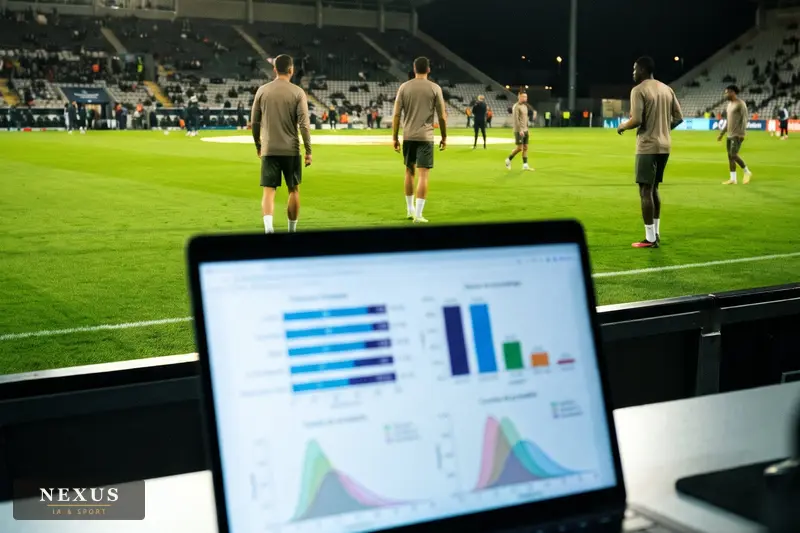
A week ago we launched the predictor match: before each round we record the probabilities from Opta, ChatGPT, Gemini and Claude, then we check. Round 1 is over, with 19 matches played from November 20 to 23 in Ligue 1 and the Premier League. The verdict is harsh: only the Opta supercomputer, scored on the Premier League, does slightly better than pure chance. The three consumer AIs stay behind.
The round 1 leaderboard
On video, in French: Karim, Sophie and Michel debate this review in the first episode of NEXUS Débrief (characters, images and voices made with AI).
Here is the ranking by accuracy score out of 100, the one that accounts for how confident each prediction was: 1. Opta supercomputer (66.8, 5 correct calls out of 10); 2. Pure chance (66.7, 6 correct calls out of 19); 3. ChatGPT (paid) (66.5, 8 correct calls out of 19); 4. Claude (64.8, 8 correct calls out of 19); 5. Gemini (paid) (64.1, 8 correct calls out of 19). Pure chance is always worth 66.7, since it takes no risk.
Opta edges past pure chance, thanks to Brentford’s win over Everton (4-0) on Monday night. ChatGPT is the best of the three AIs, at 66.5. Claude, the tool NEXUS uses to prepare its articles, finishes on 64.8, just ahead of Gemini (64.1). As promised, Claude is scored like the others.
The gaps are small, only a few points. Over a single round they mostly say one thing: this weekend, football was less predictable than the machines announced.
The upsets nobody saw
Le Mans won 3-2 at the Vélodrome. The three AIs gave Marseille a 65 to 68% chance, one of the most confident predictions in Ligue 1. It is also the one that cost them the most points.
In the Premier League, Leeds won 4-1 at Chelsea, while everyone had Chelsea as favourites at around 50%. Hull beat Brighton 2-0, when Opta and the AIs gave the visitors roughly a one-in-two chance. Manchester City, favourites at about two in three, were held 1-1 by Fulham.
Lyon won at Lille (1-0) and Brest at Strasbourg (1-0). In both cases the AIs leaned towards a home win, without much conviction.
What they got right
There were successes too. Every predictor had PSG winning at Nice, and they did (3-2). Liverpool vs Manchester United (4-0), Tottenham vs Ipswich (2-0) and Bournemouth vs Nottingham Forest (2-0) were well called.
The most interesting case is Paris FC. ChatGPT gave them a 66% chance of beating Angers, while Gemini and Claude stayed cautious at around 45%. Paris FC won 4-0. It was the only time all weekend that an AI took a real risk, and it was right.
The real problem: draws
This weekend, 6 of the 19 matches ended in a draw. Yet no predictor ever rated the draw as the most likely outcome, in any match. Their draw probabilities stayed stuck between 18 and 30%.
This is not a flaw specific to AIs. Football models, Opta included, rarely put the draw first, because it is almost never the single most likely result of a given match. But when a round has this many draws, every predictor loses points at the same time, and pure chance, which gives the draw 33%, takes the lead.
Our view: one round proves nothing
A single round is 19 matches. That is far too few to conclude that AIs cannot predict football. A study of more than 300,000 matches showed that football is the most surprising sport, because so few goals are scored. A weekend with six or seven upsets can happen to any model.
What matters is the trend over a season. If, after ten rounds, the AIs are still below pure chance, it will mean their percentages are worth no more than a coin toss. If they climb back, we will know this first weekend was an accident. See you next round, with the same rules: no betting, no NEXUS tips, just the numbers.
Key takeaway
Across 19 Ligue 1 and Premier League matches, ChatGPT, Claude and Gemini did worse than pure chance, and only Opta edged past it. Upsets and 6 draws explain the result. One round is not enough to conclude.
Frequently asked questions
Who won round 1 of the predictor match?
Opta, narrowly, ahead of pure chance. ChatGPT, Claude and Gemini did worse than chance.
Why did the AIs do worse than chance?
Because of the upsets (such as Le Mans at Marseille or Leeds at Chelsea) and the draws: 6 out of 19, while no predictor rated the draw as most likely.
Does this mean AIs cannot predict football?
Not yet. One round is too few. The leaderboard only means something over a full season.
Sources and method
This article draws on 7 sources, listed below. References checked in November 2026. Artificial intelligence tools help with research and writing: our method explains how. Found a mistake? Let us know and we will correct it and say so on the page. This article is for information and does not replace the advice of a doctor or sports professional who knows your situation.
- NEXUS IA Sport, predictor match page: probabilities collected on November 19, 2026, and method
- Opta Analyst (November 19, 2026), Premier League matchweek 11 predictions
- Ouest-France, Ligue 1 2026-27 round 11 results (in French)
- Foot Mercato (November 22, 2026), Marseille 2-3 Le Mans (in French)
- Xinhua (November 22, 2026), Premier League matchweek 11 results
- ESPN (November 22, 2026), Liverpool 4-0 Manchester United
- Ben-Naim, Vazquez and Redner (2006), “Parity and predictability of competitions”