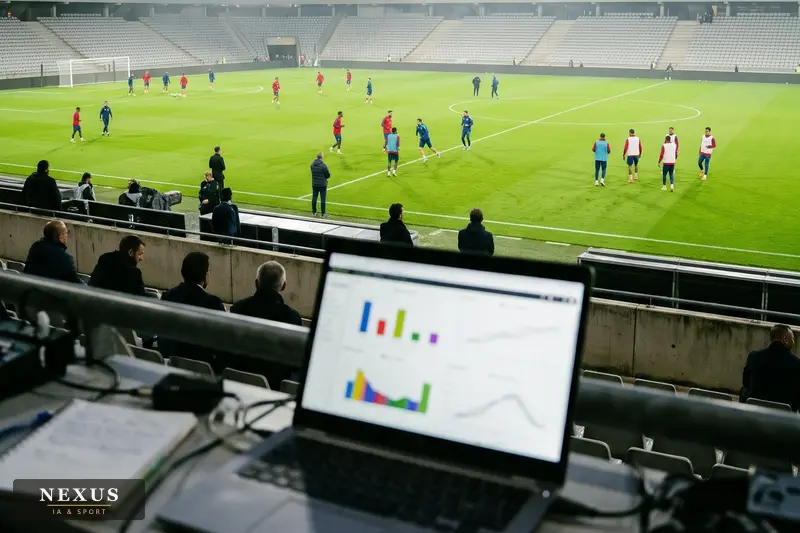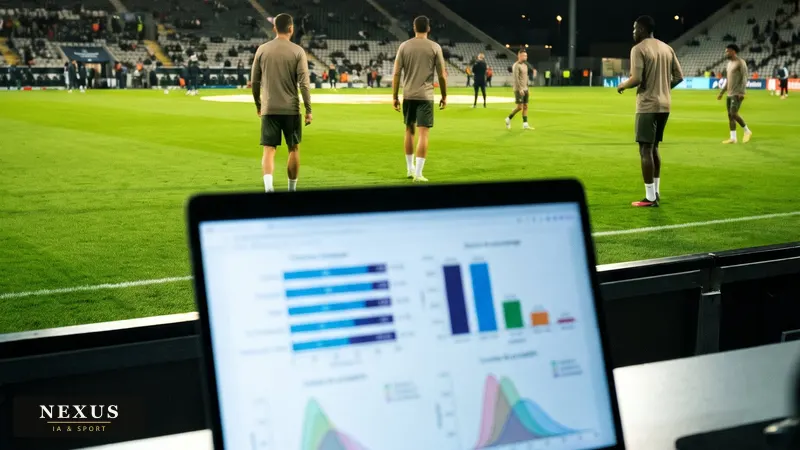
Before every big game, a supercomputer or an AI names the winner, and the press repeats the number. By Monday, nobody mentions it again. Nobody keeps score. From November 20, NEXUS does: every Premier League and Ligue 1 round, we record the predictions of Opta, ChatGPT, Gemini and Claude, then score who called it right. We make no predictions of our own and we do not talk about betting. We referee, and we explain why the machines get it wrong when they do.
Football, the hardest sport to predict
Before scoring the predictors, it helps to know what to expect. In 2006, three American physicists, Eli Ben-Naim, Federico Vazquez and Sidney Redner, compared more than 300,000 games played over a century in English football and the major US leagues. They measured how often upsets happen, meaning games where the lower-ranked team wins.
English football came out on top, with an upset index of 0.452, ahead of baseball (0.441) and far ahead of basketball (0.365) and American football (0.364). The reason is simple: very few goals are scored. A post or a red card can turn a game around, which happens far less in a sport where teams score a hundred points. The authors also noted that English football had become slightly more predictable over the decades. Even so, a predictor that gets seven games out of ten right would already be excellent.
How the Opta supercomputer works
Opta, the sports data company the press quotes most, publishes probabilities for every Premier League match each week on its site, The Analyst. Its model draws on betting market odds and on its own team strength ratings, built from results and match data, then simulates the game thousands of times.
For matchweek 10, for example, Opta gave Arsenal a 76.9% chance of beating Hull, 13.8% for a draw and 9.3% for Hull. The same model also simulates the whole season 10,000 times to estimate each club’s title chances. It is a serious method, open about its principles, but it is still an estimate: a 77% favorite fails to win almost one time in four.
What about AIs like ChatGPT?
Assistants such as ChatGPT, Gemini or Claude are not built to predict sport. They are language models: they produce a plausible answer from what they have read, and sometimes from what they find online when asked. Yet millions of people ask them before a game.
Researchers at LMU Munich, with colleagues from Cologne and Paderborn, set out to measure how good they are. Their benchmark, LLM-SoccerArena, had seven different models predict all 104 matches of the 2026 World Cup, before each game, logging every question and answer. One result stands out: letting the AIs search the web improves them only a little. Their Brier score, the error measure we will use too, improves by just 0.023.
A World Cup is a short tournament between national teams. A league like the Premier League, with injuries and mid-season managerial changes, raises different questions. That is what we will look at, week after week.
Our rules
Five predictors take part. Opta first, then ChatGPT, Gemini and Claude. The three AIs get exactly the same question, published in full on the leaderboard page, in a fresh conversation, the day before the round’s first match. The fifth is pure chance, which gives each outcome a one-in-three chance and serves as a baseline. An AI that cannot beat chance over a season adds nothing. Claude is also the tool NEXUS uses to prepare its articles: it will be scored exactly like the others.
We use two numbers. The first is correct calls: did the outcome rated most likely actually happen? The second is an accuracy score out of 100, derived from the Brier score, which punishes overconfident predictions when they are wrong. Pure chance scores about 67. A perfect predictor would score 100.
One rule will not change: no NEXUS predictions, no links to betting sites, no bookmaker odds as a predictor. The goal is to understand what the predictions you read everywhere are worth. The leaderboard, the detailed method and the exact question asked to the AIs are on the Predictor match page.
First round: November 20 to 23
The match starts as the leagues return from the international break. In the Premier League, matchweek 11 brings Newcastle vs Arsenal on Saturday and Liverpool vs Manchester United on Sunday. In Ligue 1, round 11 opens on Friday, November 20 with Troyes vs Le Havre, followed by Nice vs PSG on Saturday afternoon, Lille vs Lyon on Saturday night and Marseille vs Le Mans on Sunday.
Update, November 19: this round’s predictions are online on the predictor match page. The first surprise came before kick-off: the free versions of ChatGPT and Gemini refused to give percentages, worried they would help gamblers. So we scored their paid versions. And Opta does not publish match-by-match probabilities for Ligue 1, so it is only scored on the Premier League.
All predictions will be published before Friday’s kick-off. The review will follow on the next Monday or Tuesday, with the weekend’s upsets and what the models did not see coming.
Our take: what we expect to see
Our starting hypothesis: Opta should finish ahead of the consumer AIs, because its model is built for the job and fed with match data. The AIs should do well on big favorites such as PSG or Arsenal, and miss more often on tight games and draws, which everyone predicts badly. The real question is the gap. If ChatGPT does almost as well as a supercomputer, that says a lot about how much football it has read. If it barely beats chance, it is a reminder that a well-written answer is not an analysis.
We may also be wrong, and that is the whole point of keeping score. See you on Friday.
Key takeaway
Football is the hardest sport to predict. Every round, NEXUS scores the predictions of Opta, ChatGPT, Gemini and Claude against pure chance, with no tips and no betting, to find out what the predictions you read everywhere are really worth.
Frequently asked questions
What is the predictor match?
A round-by-round tracking of the predictions made by Opta, ChatGPT, Gemini and Claude on the Premier League and Ligue 1. NEXUS scores who was right and publishes a reliability leaderboard.
Does NEXUS give tips or betting advice?
No. We make no predictions, put no links to betting sites and do not use bookmakers’ odds as a predictor. We analyze other people’s predictions.
How are the AIs scored?
With the number of correct calls and an accuracy score out of 100, derived from the Brier score, which accounts for how confident each prediction was. Pure chance scores about 67.
Why is football so hard to predict?
Because few goals are scored. A study of more than 300,000 games found that English football produces more upsets than basketball or American football.
When does the leaderboard start?
With matchweek 11 of the Premier League and Ligue 1, November 20 to 23, 2026. Predictions come out before the first match, the review on the following Monday or Tuesday.
Sources and method
This article draws on 8 sources, listed below. References checked in November 2026. Artificial intelligence tools help with research and writing: our method explains how. Found a mistake? Let us know and we will correct it and say so on the page. This article is for information and does not replace the advice of a doctor or sports professional who knows your situation.
- Ben-Naim, Vazquez and Redner (2006), “Parity and predictability of competitions”, Journal of Quantitative Analysis in Sports, arXiv version
- Nature (January 3, 2006), football, the sport with the most frequent upsets
- Opta Analyst (November 5, 2026), Premier League matchweek 10 match predictions
- Opta Analyst (2026), Opta supercomputer predictions for the 2026-27 Premier League season
- Schröder, Schweisthal, Müller, Weinmann and Feuerriegel (July 27, 2026), “LLM-SoccerArena: Benchmarking LLMs on Real-World Predictions in Sports”, arXiv
- LMU Munich (June 12, 2026), FIFA World Cup: how well can AI predict sports results?
- Orange Sports, Ligue 1 2026-27 round 11 schedule
- Premier League, all 380 fixtures for the 2026-27 season