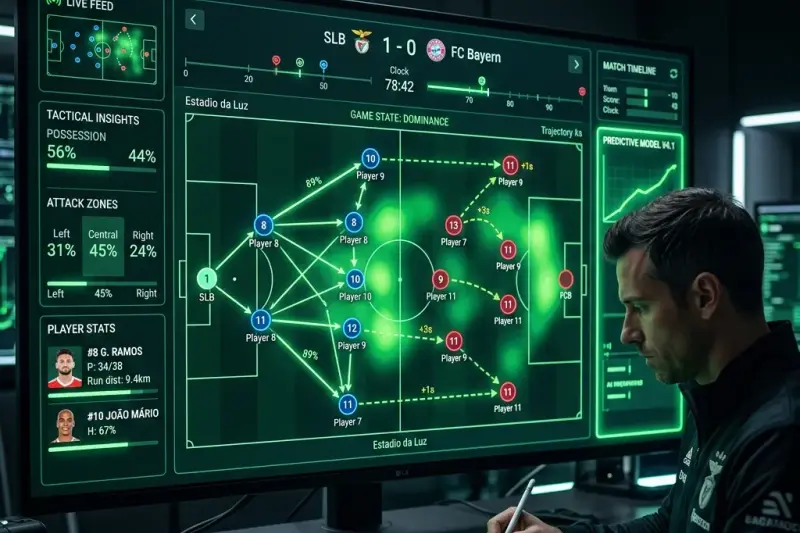
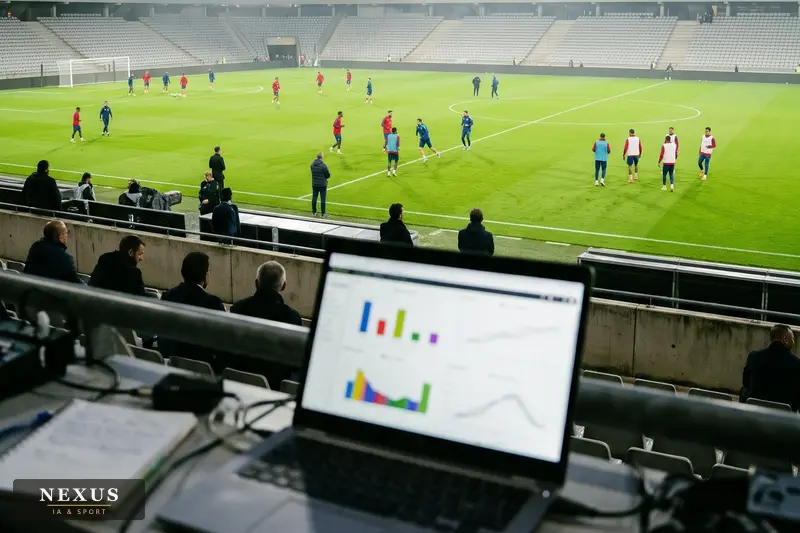
Ask a chatbot why your team lost on Saturday and you will get a fluent, confident answer about midfield overloads. It did not see the game. The most serious work on tactical AI looks nothing like that. It starts from where the 22 players were standing, and it began with corners.
Good with words, blind on the pitch
A model such as GPT learns to predict the next piece of text. That makes it handy for summarising an analyst’s report, turning notes into an opposition sheet or explaining a concept to a young player.
It does not know where anyone was in the 63rd minute. Without the data in front of it, it fills gaps with whatever sounds plausible, and it will invent a statistic or a line-up in the same assured tone it uses for facts. The flaw has a name, hallucination, and it is common enough to have had a full research survey devoted to it in 2023.
A model that thinks in positions
In 2024, Google DeepMind published TacticAI in Nature Communications, designed with experts at Liverpool FC. It reads no text. It takes the positions and speeds of the 22 players at a corner, as a graph in which each player is a point linked to the others.
Corners made sense because they are set pieces, repeated often, where a coach can really organise who stands where. The model was trained and tested on 7,176 Premier League corners supplied by the club. The project did not come from nowhere. In 2021, DeepMind researchers had already set out what AI could bring to football by combining statistics, game theory and computer vision, using penalty kicks as an example.
What it does
It predicts who is most likely to receive the ball and whether a shot will follow. It also suggests moving certain players to make a shot more or less likely.
It works as a search engine too. Show it a corner and it finds similar set-ups in the database, saving an analyst hours of trawling through video.
The 90% figure, and how to read it
Five club experts, data scientists, a video analyst and an assistant coach, assessed its work. They could not reliably tell the model’s positions from real ones. Across 50 corners, a majority judged its adjustments favourable in 45 cases.
That is 90%, and it is encouraging. It is also the opinion of five people connected to the project. It is not a trial with goals scored and conceded, and the study does not measure any effect on results.
Why it does not need billions of examples
The trick is geometry. A corner from the left looks a lot like its mirror image from the right, and TacticAI is built to use those symmetries, so it learns from fewer examples.
That matters because even a big club has only a few thousand well-documented corners. A language model has seen billions of sentences. A tactical model has to lean on the structure of the problem.
They work well together
A specialist model can produce the analysis and a language model can turn it into clear instructions for players. Used that way, the chatbot is doing what it is good at: finding the words.
The rule is that it only talks about data you gave it. The moment it answers from memory about a specific match, check every number.
Positions are not the whole corner
A corner also depends on the delivery, the timing of runs, height, late-game fatigue and an opponent who adapts after seeing your routine twice. The model proposes, and the coach decides whether these players can pull it off.
The authors describe their tool in those terms, as an assistant for exploring options. For a small club the sums are different anyway: position data are still expensive, and regular video analysis will teach you more.
What the Liverpool test does not prove
The 90% figure has been widely quoted: out of 50 corners, Liverpool’s analysts preferred TacticAI’s suggestion to the tactic actually used in 45 cases, without knowing which one came from the machine. The panel had only five experts, and the model had learned from 7,176 Premier League corners.
Above all, no player tested these setups on a pitch as part of the study, and Liverpool did not say whether it had used them in a match. An outside expert pointed out that real proof could only come from the pitch. It is the same question as for consumer AIs: a good answer on paper does not guarantee a good result, which we measure every round in our predictor match.
Key takeaway
A language model finds the words but cannot see the pitch. Serious tactical tools start from player positions, and they remain assistants to the staff.
Frequently asked questions
Can ChatGPT analyse a football match?
It can summarise or rephrase an analysis you give it. Without match data, it may invent facts that are plausible but false.
What is TacticAI?
A Google DeepMind model designed with Liverpool FC, which predicts the outcome of corners and suggests positional adjustments based on player positions.
Is TacticAI used in matches?
The published study assesses the tool with club experts. It does not measure its effect on match results.
Why focus on corners first?
They are repeated, pre-organised phases in which a coach can place each player. They lend themselves to modelling better than open play.
Can a small club use this kind of tool?
It takes good-quality position data, which is still expensive. An amateur club will gain more from regular video analysis.
Sources and method
This article draws on 5 sources, listed below. References checked in November 2026. Artificial intelligence tools help with research and writing: our method explains how. Found a mistake? Let us know and we will correct it and say so on the page. This article is for information and does not replace the advice of a doctor or sports professional who knows your situation.
- Wang et al. (2024), TacticAI, an AI assistant for football tactics (Nature Communications)
- Long version of the TacticAI paper on arXiv, with details of the expert study
- Tuyls et al. (2021), what AI can do for football, and what football can do for AI (Journal of Artificial Intelligence Research)
- Ji et al. (2023), survey of hallucination in natural language generation (ACM Computing Surveys)
- The Conversation (2024), can AI improve football teams’ success from corner kicks? Liverpool and others are betting it can