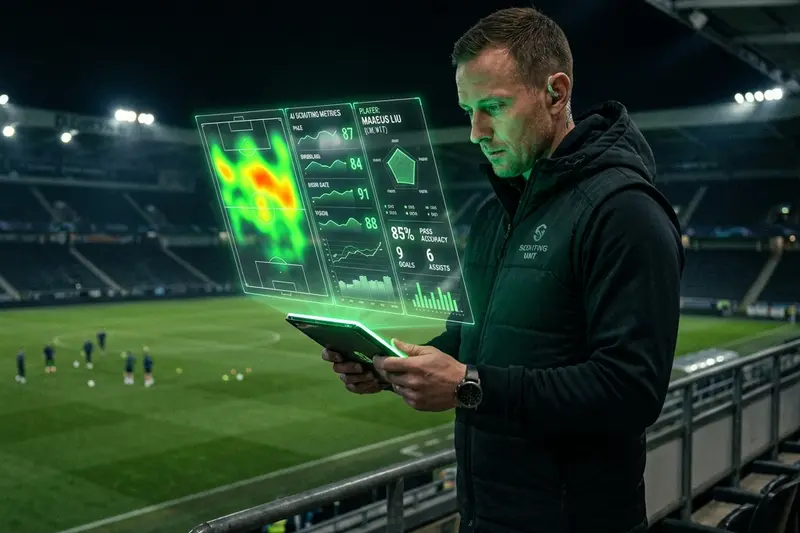
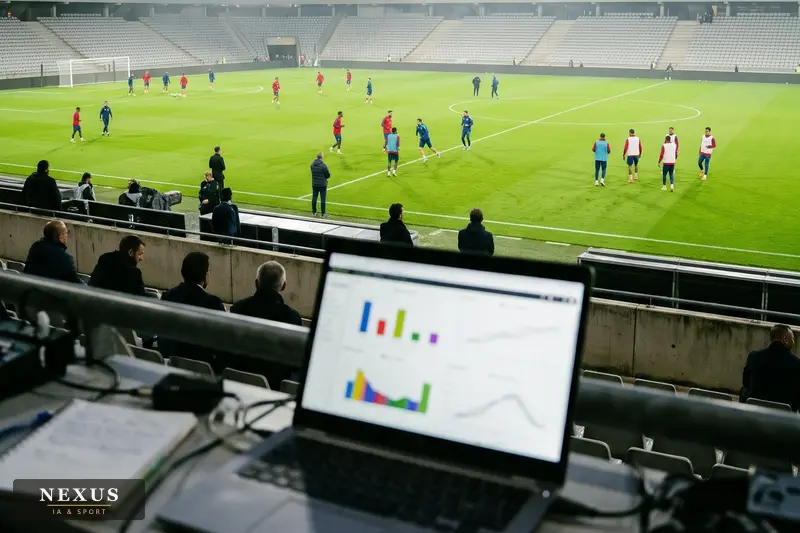
A video analyst used to lose whole days hunting for the right clips. Now the software finds every lost ball in your own half before the kettle has boiled. That has freed up enormous amounts of time, which has made one thing obvious: finding the footage was never the difficult part.
Computer scientists and coaches need each other
In 2021, Floris Goes and colleagues reviewed tactical analysis from player position data. Of 2,338 studies, they kept 73, from sports science and computer science.
Each field brought something, but they often worked apart. The best results came when programmers and coaches built the indicators together. As early as 2016, Robert Rein and Daniel Memmert warned that the sheer volume of data was becoming an obstacle in itself, for want of method and theory to read it. The measurements are sound, though: a validation study of an optical tracking system used in stadiums found a position error of 8 to 9 centimetres against a laboratory system.
Three sources, one job
Analysts work with three raw materials: video, still the reference for understanding an action; event data, listing every pass, shot and duel; and tracking data, giving every player’s position several times a second.
AI’s value is in connecting them. When a model recognises that your team just lost the ball in its own half, it can pull the clip and file it alongside every similar moment of the season.
What is now automated
Cutting matches into sequences, tagging phases of play and calculating indicators such as pressing intensity. PPDA, for one, counts how many passes a team allows before trying to win the ball back. Vision models also pick up formations, block height and the gaps between lines.
That used to take hours by hand. It now takes minutes.
Begin with a question
Dashboards are a good way to drown. Staff get further with a specific question: when does our press leave a pass open through the middle? Which build-up does the next opponent use most? That decides what is worth looking at.
An indicator with no comparison rarely helps. Tie it to a phase of play, an opponent and clips you can show the players.
What the machine cannot see
An open passing lane on a frame may be a trap. A run off the ball may answer an instruction no dataset records. Automatic labels always need checking, and a good report says what period it covers and what is missing, so nobody draws a tactical truth from two matches.
Preparing for opponents carries the same risk. A team that changed coach three weeks ago may no longer play as its season stats suggest. The context of each match counts as much as the numbers.
Show less
Effective video sessions are short, often about ten minutes. Players remember three clear situations far better than twenty mistakes.
Clips sent to phones are now common, and they work provided someone tells the player what to look for.
The rookie errors in analysis reports
Too many numbers is the classic. Nobody reads twenty pages. Comparing unlike matches is another, such as a home game against a promoted side and a trip to the league leaders.
Confirmation bias is the sneakiest. It is easy to find clips that support what you already think. Good analysts go looking for the footage that proves them wrong, and they show it.
Who gets hired
Pro clubs now have whole departments, with video analysts, data scientists and sometimes specialists in recruitment or set pieces.
The person everyone wants speaks both languages. They understand a statistical model and know what a coach needs from a ten-minute session. That is often the difference between a tool that gets used and one that gets forgotten. Amateur clubs need none of this to start: a phone on a tripod, free clipping software and a few indicators noted by hand will do.
Tracking players from the TV picture alone
Some clubs no longer need cameras installed in the stadium: companies such as SkillCorner rebuild the position of all 22 players and the ball from the broadcast footage. SkillCorner tested its system at Sunderland’s Stadium of Light with ten cameras placed at different heights and angles, and compares it with the Premier League’s official tracking. The company says accuracy held up in every case.
These are results published by the company itself, with no independent peer-reviewed study. Liverpool worked with SkillCorner for a year to refine the algorithm before signing. The data is mostly used for recruitment, as Como (in French) does, and for matches nobody films with a full system, such as youth games.
Key takeaway
AI saves hours of searching. It will not tell you why your team lost the midfield.
Frequently asked questions
Can AI replace a video analyst?
No. It finds and sorts clips, and the analyst links them to instructions and the context of the match.
Why does video remain important?
Position data show neither intention, nor communication between players, nor a precise tactical instruction.
What is PPDA?
Passes allowed per defensive action by the opponent. The lower it is, the higher and earlier a team presses.
Can an amateur club do video analysis?
Yes. A phone on a tripod, free clipping software and a few indicators noted by hand are enough to improve.
Do you need to know how to code to become a video analyst?
Not necessarily at the start, but data skills are increasingly in demand at professional clubs.
What software do video analysts use?
Professional clubs use specialist video clipping and annotation software, often linked to suppliers’ data. Amateur clubs can find free or cheap tools that are enough to begin with.
How long should a good video session with players last?
Often about ten minutes, with a few clear messages. Beyond that, attention drops and players retain the key points less well.
Sources and method
This article draws on 5 sources, listed below. References checked in November 2026. Artificial intelligence tools help with research and writing: our method explains how. Found a mistake? Let us know and we will correct it and say so on the page. This article is for information and does not replace the advice of a doctor or sports professional who knows your situation.
- Goes et al. (2021), big data and tactical analysis in football, systematic review (European Journal of Sport Science)
- FIFA, football innovation and technology
- Rein and Memmert (2016), big data and tactical analysis in elite football (SpringerPlus)
- Linke, Link and Lames (2020), accuracy of an optical tracking system in football (PLOS ONE)
- SkillCorner, does camera position and capture style affect tracking quality? (company test)