Remember the long, painful minutes while someone in a dark room dragged lines across a frozen screen? Since the 2022 World Cup, semi-automated offside has been doing that job in seconds. It is a real improvement. It also leaves the hardest part of the offside law exactly where it always was.
Cameras track the bodies, the ball marks the moment
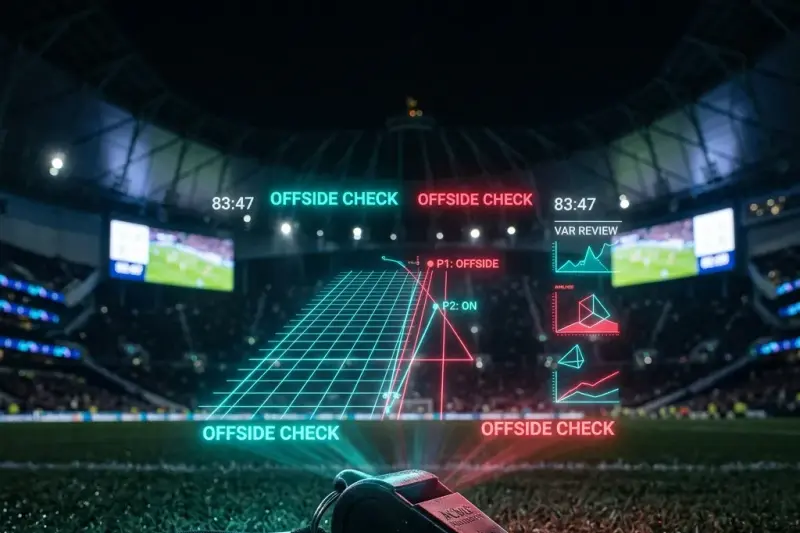
About a dozen cameras under the stadium roof follow up to 29 points on each player’s body, roughly 50 times a second. A sensor in the ball detects the moment of the pass. Put together, the software knows when the ball was played and where everyone stood at that instant, and it alerts the video team, who check before passing the decision to the referee.
The ball sensor is the clever part. Cameras at fifty frames a second capture one image every twenty milliseconds, and a sprinting player can move more than twenty centimetres between frames. Picking the right frame was the main source of error with hand-drawn lines. The vision scientist George Mather calculated in 2020 that at 50 images a second the moment of contact is judged on average 10 milliseconds late, which makes offside calls more likely in fast play. The sensor reads impacts about five hundred times a second, far more finely than video can.
What the law actually says
You are in an offside position if any part of your head, body or feet is in the opposition half and closer to the goal line than both the ball and the second-last opponent. Arms and hands do not count, up to the bottom of the armpit.
There is no offside from a throw-in, corner or goal kick. Being level is onside, and being in an offside position is not an offence in itself. You also have to take part in play or interfere with an opponent.
The part a machine cannot judge
That last clause is why the referee still decides. Is a forward interfering with the goalkeeper’s line of sight? Did a defender deliberately play the ball, which can cancel the offside? The machine gives you a position. Influence on the game is a judgement.
What the system removes is the slow, error-prone job of measuring.
A law that keeps moving
Offside dates from the early days of codified football in the 19th century and has repeatedly been changed to help attackers. In 1925, the number of opponents required between attacker and goal line dropped from three to two, and goals immediately went up.
The 1990 rule that level is onside is exactly what technology now measures to the centimetre, sometimes producing decisions that feel absurd when the margin is a toe.
Where the debate is going
UEFA brought the system into the Champions League in 2022-23 and several big European leagues followed. The 3D animation shown in stadiums has helped crowds accept decisions, and for the 2026 World Cup FIFA announced further steps, including cameras worn by referees.
The argument has now moved on to the law itself. Arsène Wenger, in charge of global football development at FIFA, has argued for years that a player should be offside only if their whole body is ahead of the defender.
Spare a thought for the Sunday league assistant
Lower down the game there are no cameras and no sensor, just an assistant referee, if you are lucky, and wherever they happen to be standing. One who is level with the second-last defender sees far better than one a few metres behind.
Studies of officiating put the errors down less to that gap than to perception itself. At the 2002 World Cup, 26.2% of the 337 offside judgements analysed were wrong, and correct and incorrect calls came from assistants standing in much the same place. A study of a full season of the German top flight even found fewer errors when the assistant was further from the action, because the players then fit into a narrower field of view. Technology has exposed those errors at the top. It has also shown how hard the job is everywhere else.
Key takeaway
Semi-automated offside measures better than any human eye. Deciding whether a player interfered is still the referee’s job.
Frequently asked questions
Does semi-automated offside decide on its own?
No. It provides position information, which the video team checks before the referee decides.
Why do some decisions still take time?
When officials have to judge whether a player is taking part in the action, analysis of the full sequence is still needed.
Do arms count for offside?
No. Only the head, body and legs count. The limit of the arm is at the bottom of the armpit.
Can you be offside from a corner?
No. Offside does not apply from a corner, a throw-in or a goal kick.
Is a player level with the defender offside?
No. Since 1990, a player level with the second-last opponent has been considered onside.
Can semi-automated offside get it wrong?
Like any measurement it has a margin of error, linked mainly to camera frame rate. It is much smaller than with hand-drawn lines.
Why are offside decisions so tight?
Because the rule counts any part of the body that can score. A toe or a shoulder ahead is enough, and technology makes that visible.
Sources and method
This article draws on 5 sources, listed below. References checked in November 2026. Artificial intelligence tools help with research and writing: our method explains how. Found a mistake? Let us know and we will correct it and say so on the page. This article is for information and does not replace the advice of a doctor or sports professional who knows your situation.
- FIFA, innovations planned for the 2026 World Cup
- FIFA, football innovation and technology
- Helsen, Gilis and Weston (2006), offside errors at the 2002 World Cup (Journal of Sports Sciences)
- Hüttermann, Noël and Memmert (2017), offside errors over a season of German top-flight football (PLOS ONE)
- Mather (2020), the vision science of offside calls by VAR (Perception)