A midfielder breaks a line with one pass. A defender steps in and the danger never happens. Neither shows up on the stats sheet, yet both can decide a match. For years that was the blind spot in player recruitment, and the models built to fill it now sit behind some of the smartest signings in football.
Scoring the actions nobody counts
In 2019, Tom Decroos and colleagues at KU Leuven presented VAEP, a method for valuing those invisible moments. The idea is easy to explain. After every pass, dribble or tackle, the model asks whether the team’s chances of scoring or conceding went up or down in the actions that followed. The change becomes the rating for that action.
That same year Luca Pappalardo and an Italian team published PlayeRank, which ranks players from millions of match events supplied by Wyscout. When they compared its rankings with the opinions of professional scouts, the two agreed better than with the other methods tested. They still did not always agree.
Expected goals, the model everyone knows
Before VAEP, football had already embraced expected goals, or xG. Each shot gets a probability of going in, based on position, angle, body part and the kind of pass before it.
A striker who beats their xG by a long way over a season might be an exceptional finisher or might be lucky. Over several seasons the gap often shrinks. Scouts look at both figures, and above all at how many chances a player is getting.
Two kinds of data, and why one is scarce
Event data record each action on the ball: a pass, where it started and ended, who played it. Tracking data record the position of every player and the ball several times a second.
Specialist suppliers offer event data for thousands of matches worldwide. Tracking data are richer but far rarer outside the top leagues. That is why most recruitment models still run on events, and why they share one flaw: they only see the ball. Newer work goes after that flaw: in 2021 Javier Fernández and colleagues published a model that values every instant of a possession from the positions of all 22 players and the ball. It needs tracking data.
The funnel at Brentford and Midtjylland
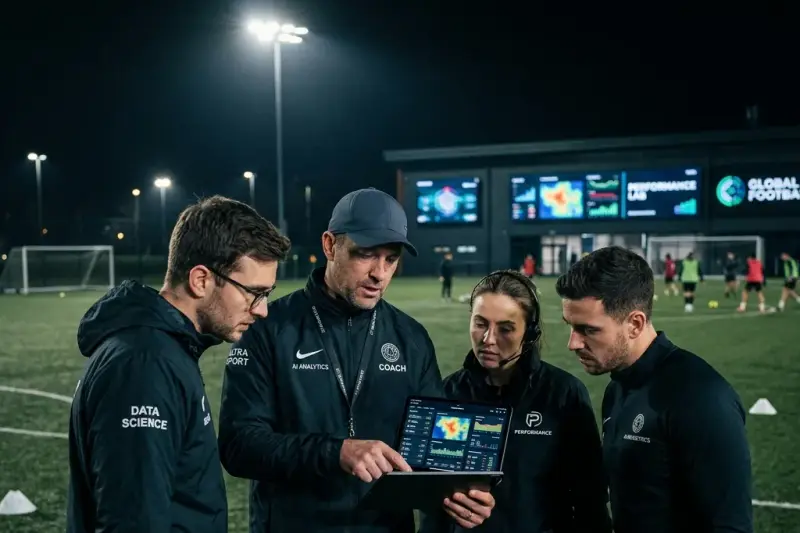
Clubs such as Brentford in England and FC Midtjylland in Denmark made their names by backing data early. Their process works like a funnel. Models shrink thousands of players down to a few dozen who fit what the team needs.
Then people take over: video, trips to matches, questions about character and health. At every stage humans knock out candidates the numbers liked. The data are there to make sure nobody good gets missed. They do not sign anyone. What those people look for is not what the numbers hold. In a 2017 survey, twenty Australian youth recruiters and coaches ranked technique, decision-making and traits such as coachability at the top.
Where the numbers mislead you
League level is the first trap. Dribbling past people in a division with more space is not worth the same as doing it in the Premier League, and models have to correct for that. Tactical role is the second: a full-back who crosses a lot may simply be doing what the coach demands.
Small samples catch people out too. Ten good matches can make a teenager look like a star on paper. And no statistic tells you how someone will cope with a new country, a new language and a dressing room full of strangers. Off-ball positioning, communication and attitude in training all escape the models as well.
The January birthday problem
With young players the data get thinner and more misleading. A 15-year-old born in January can be nearly a year ahead physically of a teammate born in December. This relative age effect is well documented, and early-year birthdays are over-represented in academies.
A model that rates current performance will amplify that bias. The careful clubs adjust for date of birth, or look at how fast a player is improving rather than how good they are today.
The women’s game needs its own models
Women’s football went without good data for a long time. Few matches were covered and models were built on the men’s game. That is improving quickly as leagues and TV deals grow.
Dropping a men’s model straight onto the women’s game is still a mistake. Speeds, distances and styles of play differ, so the indicators have to be recalibrated.
Key takeaway
Data save scouts a huge amount of time. They do not replace going to watch someone play.
Frequently asked questions
What is VAEP?
A method that rates each action by its effect on the chances of scoring or conceding in the moments that follow.
Can data spot a young talent?
Less easily. There are few filmed and coded matches for young players, and progress counts for more than current level.
What does xG mean?
Expected goals: the probability that a shot produces a goal, calculated from thousands of comparable shots.
Can an amateur club recruit with data?
On a small scale, yes: film your matches, note a few key actions and compare players over time. Professional models need data an amateur club does not have.
What is the relative age effect?
The fact that young players born early in the year, who are physically more mature, get selected more often than those born late in the year.
Which clubs use data most for recruitment?
Brentford in England and FC Midtjylland in Denmark are often cited as examples. Today most professional clubs have a data department.
What is Wyscout?
A platform of match data and video used by clubs and agents around the world to find and assess players.
Sources and method
This article draws on 4 sources, listed below. References checked in November 2026. Artificial intelligence tools help with research and writing: our method explains how. Found a mistake? Let us know and we will correct it and say so on the page. This article is for information and does not replace the advice of a doctor or sports professional who knows your situation.
- Decroos et al. (2019), Actions Speak Louder than Goals, the VAEP method (ACM KDD)
- Pappalardo et al. (2019), PlayeRank (ACM Transactions on Intelligent Systems and Technology)
- Fernández, Bornn and Cervone (2021), expected possession value from tracking data (Machine Learning)
- Larkin and O’Connor (2017), what recruiters look for in youth footballers (PLOS ONE)