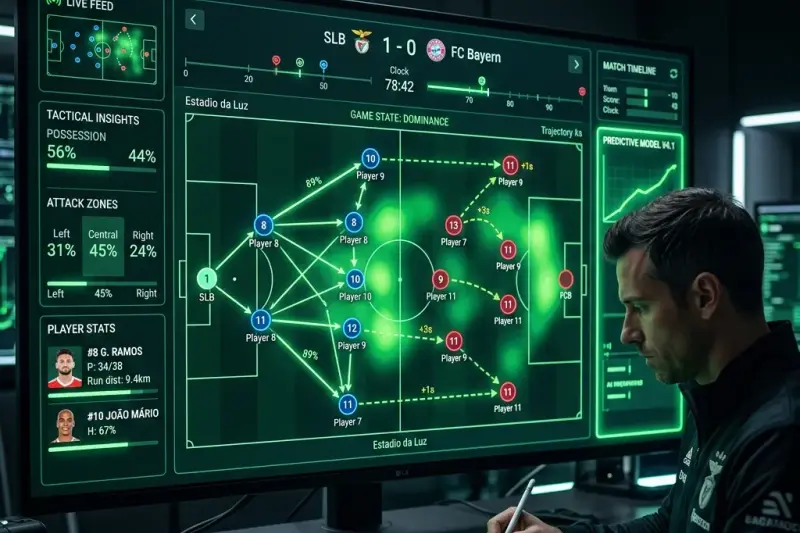
Every player on an NFL field carries two small chips in their shoulder pads, and there is another in the ball. Several times a second, the stadium knows where everybody is, how fast they are moving and which way they are facing. Broadcasters love the numbers it produces. The bigger story may be what the league is doing with them to protect players.
How the tracking works
The system uses RFID technology from Zebra Technologies, an NFL partner since 2014. Each chip sends a signal several times a second, and about twenty receivers around the stadium fix its position by triangulation, to within centimetres.
Two chips per player gives more than location. It gives orientation, and knowing whether a receiver is facing the quarterback or turned away can change how you read a play.
Stats that did not exist before
For fans, the output is familiar: a receiver’s top speed, or how much separation they had when the ball was thrown. Coaches get complete routes, play after play, to compare from one game to the next.
Tracking also created new measures. Completion probability, for example, accounts for pass length, the gap between receiver and defender, and pressure on the quarterback. Since 2019 the league has run the Big Data Bowl, an open contest in which analysts around the world get real tracking data and try to invent better measures. Several of their ideas have been adopted.
The real prize: fewer head injuries
Concussions have been the NFL’s biggest issue for more than fifteen years. By combining video with tracking data, the league found the moments when head impacts were most common, such as some kick-offs with players at full speed. One study reviewed video of every reported concussion in games across the 2015 and 2016 seasons: half came on passing plays, 21% on punts or kick-offs, and cornerbacks were hit most often. In college football, the Ivy League changed its kick-off rule in 2016, and a study in JAMA compared concussions before and after.
Since 2022, linemen, tight ends and linebackers have had to wear Guardian Caps, padded helmet covers, for part of practice. In 2024 the league adopted a new kick-off format with fewer full-speed run-ups. It also runs a programme with Amazon Web Services called Digital Athlete, which combines video, tracking and injury history to find risky situations and then change rules or equipment.
None of that is an AI predicting that a named player will get hurt next Sunday, and it helps to be clear about the difference.
From the Combine to game film
Every year before the draft, college prospects go through the Combine: the 40-yard dash, the vertical jump, the bench press. Those numbers once carried huge weight.
Tracking has shifted that. Teams can now see the speed a player actually reaches in a game and how well they get open, rather than relying on a test run in shorts on a track.
What a chip cannot know
A chip knows where a player is, not what they were told to do. A cornerback who lets a receiver run free may be following a zone call perfectly. Without the play design, the data can make a good decision look like a blown coverage.
That is why analysts still watch film. The tracking tells them where to look. It does not tell them what they are seeing.
Who owns the numbers?
This is settled in the collective bargaining agreement between the league and the players’ union, the NFLPA. Position data feed public statistics. Biometric data such as pulse or sleep fall under stricter rules.
Other sports could learn from that. The rules were negotiated collectively, not set club by club.
Why football got there first
The NFL’s approach has spread. The NBA tracks players with cameras in every arena, and European football leans on optical tracking and GPS. In each case the aim is to measure what happens away from the ball.
American football had a head start for a simple reason. It comes in short plays from fixed starting positions, and that structure makes it far easier to analyse than a game that never stops.
Key takeaway
The NFL’s chips have made the game measurable to the centimetre. To understand a play, you still need the film and the playbook.
Frequently asked questions
Do NFL players wear GPS?
Not GPS in the usual sense. They are RFID chips located by receivers installed in the stadium.
Are these data used for sports betting?
Some of the statistics are public and can be used by anyone, including betting operators. Detailed team data stay internal.
Does the NFL ball contain a chip?
Yes, the league also tracks the ball, which makes it possible to measure the speed and path of passes.
Do Guardian Caps reduce concussions?
The NFL has reported a fall in practice concussions for the positions concerned, but researchers still debate the exact effect.
What is the NFL Combine?
A week of physical and medical tests held every year before the draft to assess young players.
What are Next Gen Stats?
NFL statistics calculated from the chips in players’ shoulder pads and in the ball: speed, distances, separation, probability of completing passes.
How many players does the NFL system track?
All the players on the field in every game, as well as the officials and the ball.
Sources and method
This article draws on 4 sources, listed below. References checked in November 2026. Artificial intelligence tools help with research and writing: our method explains how. Found a mistake? Let us know and we will correct it and say so on the page. This article is for information and does not replace the advice of a doctor or sports professional who knows your situation.
- NFL Football Operations, overview of Next Gen Stats
- NFL, artificial intelligence for player health
- Lessley et al. (2018), video analysis of NFL concussions, 2015 and 2016 seasons (American Journal of Sports Medicine)
- Wiebe et al. (2018), the experimental kickoff rule and concussions in the Ivy League (JAMA)