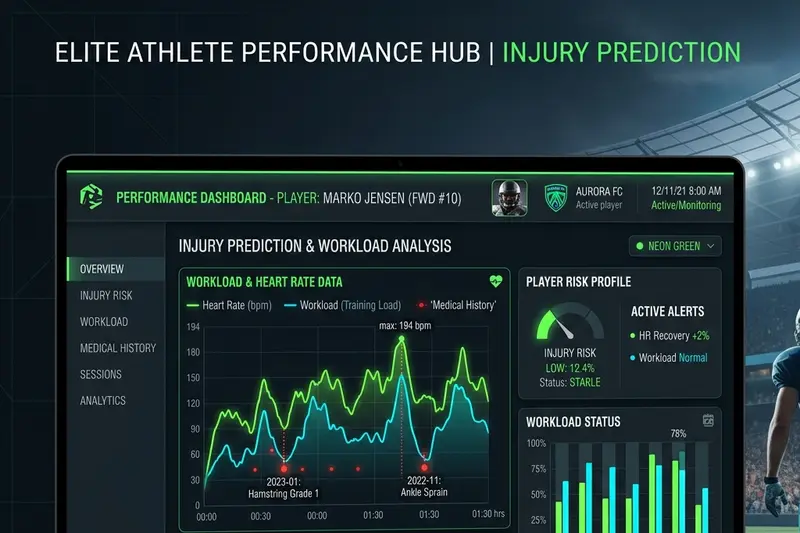
Imagine a dashboard that tells you on Friday which of your players will pull a hamstring on Saturday. Plenty of companies will sell you something close to that. The people who have actually reviewed the science are far less excited.
204 models and no outside test
In 2022, Garrett Bullock and colleagues examined 30 studies and 204 injury prediction models in sport. Not one study had tested its model on a population outside the one that built it. And 98% of the models carried a high or uncertain risk of bias.
A 2026 review of football led by M. Aslani, covering 22 studies, found definitions, data and methods so different that results could not even be compared.
Why a model that works here fails there
A model learns one club’s players, habits and sensors. Move it elsewhere and it meets different training and different measurements, and its accuracy can slide with nobody noticing. That is why external validation matters, and why its near-total absence is such a problem.
Prediction is also hard for a basic reason. An injury is rare for any one player in a season, and it depends on load, sleep, stress, the pitch and bad luck in a tackle. With few examples and many causes, a model easily finds patterns that exist only in one club’s data.
Knowing the risk is not the same as predicting it
We know some risk factors well. A previous hamstring injury is among the best predictors of another. Age and spikes in load come up often.
But a risk factor across a squad does not tell you what will happen to one person. Roald Bahr made the point in the British Journal of Sports Medicine in 2016: screening tests fail to predict individual injuries, even when they are linked to risk on average.
The false alarm problem
If a system flags several at-risk players every week and they stay fit, staff stop listening. Then they miss the one week it was right.
Used modestly, a model can still ask a good question: does this player deserve a closer look? The answer should come from the medical staff and a conversation with the player.
What already works, no AI needed
The best-evidenced prevention is almost embarrassingly simple. The Nordic hamstring exercise cuts this injury by about half in several meta-analyses, if it is done regularly. The FIFA 11+ warm-up has shown a clear fall in injuries among amateurs who use it.
The challenge is keeping it going. Teams that drop these programmes after a few weeks lose most of the benefit. No algorithm can do your Nordics for you.
Where the data do earn their place
Coming back from injury is the riskiest time, and a player who returns too soon is more likely to get hurt again in the same place. Load data can confirm they are gradually getting back to match intensities, and tracking sprints and changes of direction shows they have done those efforts in training before they play.
It is unglamorous and it works, and it is a long way from the promise of prediction.
Ask the salesperson
Has the model been tested on teams other than the one that built it? How many false alarms for each real injury detected? What data do you need, and who owns them afterwards?
A serious supplier answers with numbers and talks openly about limits. If all you hear is “up to 30% fewer injuries” with no published study, walk away.
The best sensor is still the player
A new pain, odd stiffness, tiredness that will not lift: these are valuable signals if the player dares to mention them.
At clubs where people fear losing their place, they stay hidden. A culture in which you can admit something hurts does more for prevention than most tools on the market. For amateurs, the rule is simpler still: pain or lost strength means seeing a professional, whatever your watch says.
The latest reviews, 2025 and 2026
The review by Leckey and colleagues, published in 2025 in the BJSM, shows that football is the most studied sport. Random forest or XGBoost models often do best, but a simple logistic regression did better in 4 studies out of 12. Three studies reported very high scores, which the authors consider hard to believe in practice.
A 2026 review in the Journal of Sports Science and Medicine, focused on non-contact lower-limb injuries, points the same way. The models separate at-risk players correctly on paper, but an overall score can hide that they miss most real injuries, which remain rare in the data. It calls for validation on large groups followed over time. Romain Ntamack’s case (in French) is a reminder that a collision on the pitch escapes this kind of model.
Key takeaway
No injury prediction model has yet proved itself outside the club that built it. That alone should keep the doctor in charge.
Frequently asked questions
Can AI predict an injury with certainty?
No. It can flag a period that deserves assessment, nothing more.
Which data are most useful?
Load, history and certain movement measures come up often. Their value depends mainly on the quality of collection.
Which exercise has the most evidence against hamstring injuries?
The Nordic exercise, done regularly. Several meta-analyses show a large reduction in these injuries.
Is the FIFA 11+ programme suitable for amateurs?
Yes, it was designed for them. It replaces the usual warm-up and takes about twenty minutes.
When can you return after a muscle injury?
The timing depends on the injury. The return should be gradual and approved by the medical staff, with sprints back in training before a match.
Can GPS prevent injuries?
It helps follow load and avoid sudden rises, which is part of prevention. It does not on its own predict who will get injured.
Why do footballers injure their hamstrings so much?
These muscles work very hard during sprints, as the leg extends forward. Fatigue and previous injuries increase the risk.
Sources and method
This article draws on 7 sources, listed below. References checked in November 2026. Artificial intelligence tools help with research and writing: our method explains how. Found a mistake? Let us know and we will correct it and say so on the page. This article is for information and does not replace the advice of a doctor or sports professional who knows your situation.
- Bullock et al. (2022), reliability of injury prediction models in sport (Sports Medicine)
- Aslani et al. (2026), machine learning and injury prediction in footballers (Journal of International Medical Research)
- Leckey et al. (2025), machine learning and injury risk in sport (BJSM)
- Bahr (2016), why screening tests do not predict injuries (BJSM)
- van Dyk et al. (2019), Nordic exercise and hamstring injuries, meta-analysis (BJSM)
- Soligard et al. (2008), warm-up programme and injuries in female footballers (BMJ)
- Yuan et al. (2026), machine learning and non-contact lower-limb injuries, systematic review (Journal of Sports Science and Medicine)