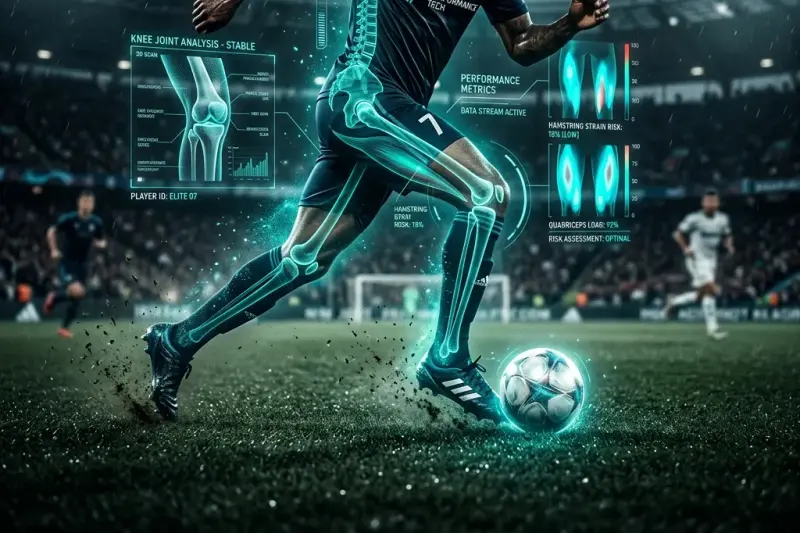
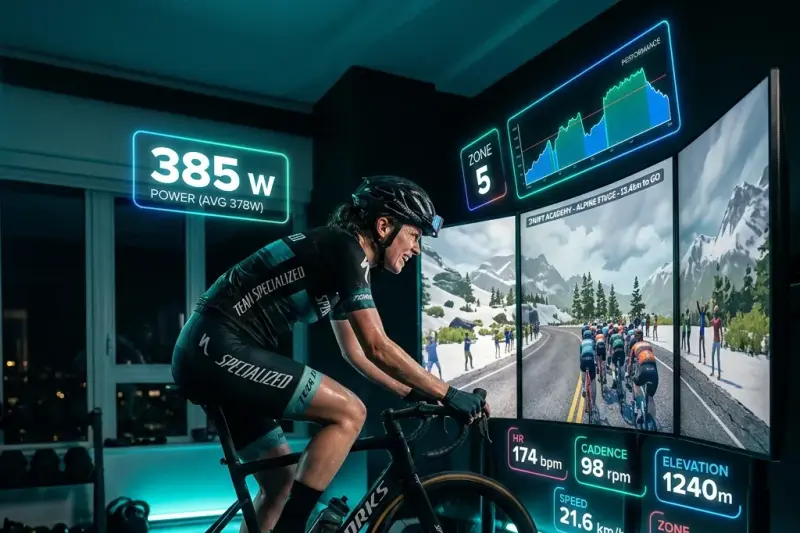
Almost every professional club now straps a GPS unit between its players’ shoulder blades and gets a dashboard full of decimal places in return. Decimal places look like truth. Two recent reviews suggest that some of those numbers rest on shakier ground than the people reading them realise.
A hard look at PlayerLoad
PlayerLoad is the most widely used accelerometer measure of external load in the world. It adds up changes in acceleration in three directions. In 2025, Craig Staunton and colleagues published a harsh critique: shifting definitions, arbitrary units and data filtering that is not transparent.
They also found only a weak link with real performance. That does not make it useless, but you should know what it measures before you make decisions with it.
Even an acceleration is hard to count
In 2021, a team led by R. Delves listed every way studies of elite team sports count accelerations and found a great many, with different thresholds and calculations.
So two devices or two software packages can give different numbers for one session. Check that the method matches before you compare players or seasons.
External load is only half the story
External load is what a player did: distance, sprints, jumps. Internal load is how their body took it: pulse, fatigue, recovery. Two players can cover the same ground and have very different sessions.
GPS sees only the first half, and it does not work indoors, where teams rely on local positioning or accelerometers alone. That is why it is nearly always paired with some measure of how the player felt.
The cheapest measure may be the best one
After a session, the player rates effort from 0 to 10, and you multiply that by the minutes. Carl Foster described session RPE in the early 2000s, and it survives because it costs nothing.
It has flaws, since players may play down their effort so as not to look tired. Tracked over time, though, it often says more than plenty of sophisticated indicators.
The ratio that everyone adopted too fast
For years many clubs tracked the acute-chronic ratio, last week’s load against the last four. The idea behind it, that sudden jumps raise injury risk, still holds.
The ratio itself has been heavily criticised on statistical grounds, and several researchers now advise against using it as an alert. It is a good reminder of how quickly an indicator can spread before anyone properly tests it.
Build a dashboard people will use
A good one fits on a screen and answers real questions. What load suits this player returning from injury? Who ran far more than usual this week? If a number cannot trigger a decision, drop it.
Traffic lights are fine as a way to start a conversation. A red player may be fine, and a green one may be hiding pain. An odd spike might be a position change, a particular drill or a signal error, so check the context first.
The use that stands up best
Return from injury is where load data earn their keep. You know a player’s usual match values for high-intensity distance and sprints, so you can check they are getting back to them in training before they play.
It is less exciting than predicting injuries. It rests on simple logic you can verify, and it gives the player something concrete to aim for.
Someone has to translate
A coach who does not know how an indicator is calculated can make it say anything. Teaching staff the basics prevents plenty of mistakes.
The fitness coach often acts as translator, boiling the data down to a few clear messages for the head coach and keeping the detail for the medical team.
Key takeaway
A load number is only worth something if you know how it was calculated. Otherwise it just looks precise.
Frequently asked questions
Can a load score say a player is tired?
Not on its own. It describes part of the work done, which how the player feels and their health must complete.
Why do two devices give different numbers?
The sensors, sampling rates, filters and calculations are not the same. Compare data obtained in the same way.
What is session RPE?
An effort rating from 0 to 10 given by the player after the session, multiplied by its duration. It is a simple measure of perceived load.
Does GPS work indoors?
No, the satellite signal does not get through. Indoors, teams use local positioning systems or accelerometers alone.
How many indicators should you follow?
As few as possible. A few well-understood indicators linked to decisions are better than an overloaded dashboard.
What is PlayerLoad?
An indicator calculated from the accelerometers in GPS units, which adds up changes in acceleration in three directions. It describes part of the mechanical work done.
Do consumer watches measure load?
They offer load scores based mainly on heart rate. These can help follow a trend, with the same limits as professional indicators.
Sources and method
This article draws on 4 sources, listed below. References checked in October 2026. Artificial intelligence tools help with research and writing: our method explains how. Found a mistake? Let us know and we will correct it and say so on the page. This article is for information and does not replace the advice of a doctor or sports professional who knows your situation.
- Staunton et al. (2025), PlayerLoad and accelerometer measures, critical appraisal (Frontiers in Sports and Active Living)
- Delves et al. (2021), quantifying accelerations in elite team sports (Sports Medicine Open)
- Foster et al. (2001), session RPE for monitoring training (Journal of Strength and Conditioning Research)
- Impellizzeri et al. (2020), the limits of the acute-chronic ratio (IJSPP)