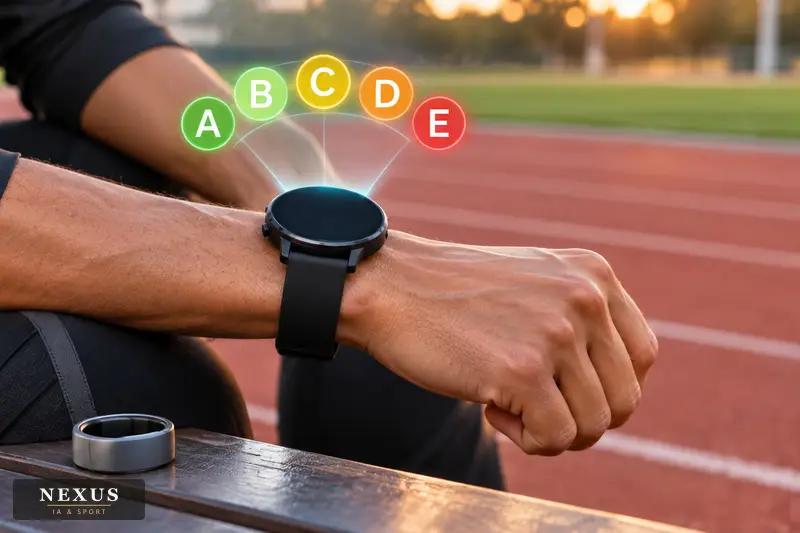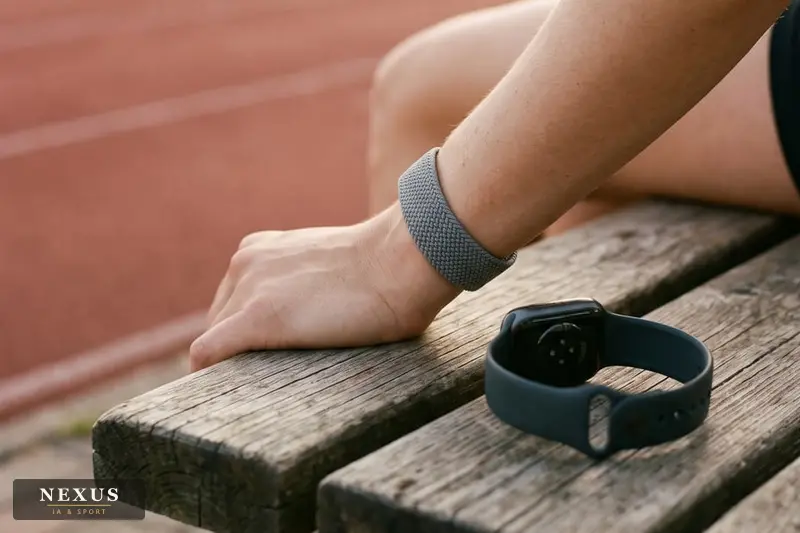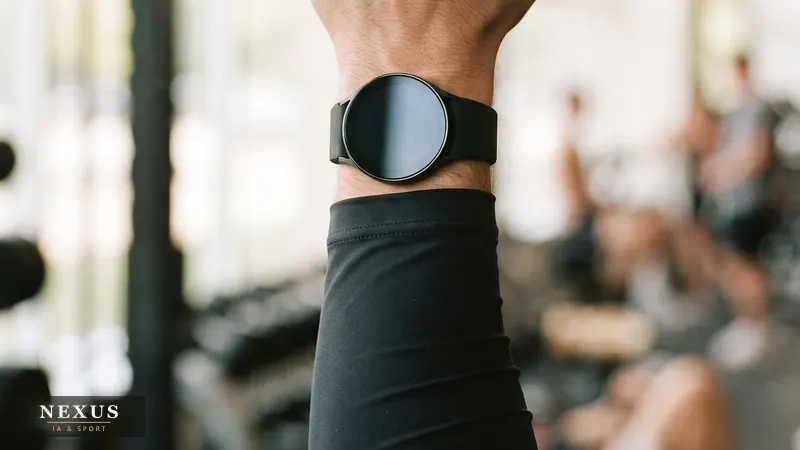
Your watch counts your steps and measures your heart rate, but it has no idea whether your squat is any good. Researchers at Cornell University want to change that. Their system, EchoMotion, tracks the position of the whole body, from head to ankles, with a single watch on the wrist. No camera, no sensors stuck everywhere: just ultrasound and a small AI model. And the most interesting part is that it already works on off-the-shelf watches.
How a watch can “see” your body
EchoMotion works a bit like a submarine’s sonar. The watch’s speakers send out ultrasound that human ears can’t hear. The sound bounces off the arms, legs and torso, and the watch’s microphones pick up the echoes.
Each posture sends back a slightly different echo. A deep learning model has learned to turn those echoes into body position. The prototype, a 3D-printed watch replica, had a speaker and a microphone on each side. Commercial watches only have one pair, which makes the job harder.
The project comes from Cornell’s SciFi Lab, led by Cheng Zhang. The lead author is Saif Mahmud, a doctoral student in information science. The study was presented on October 13, 2026 in Shanghai, at UbiComp/ISWC, the main international conference for wearable computing research.
How accurate is it?
The researchers first had 10 volunteers wear the watch on their non-dominant wrist during 18 exercises. They compared what the watch saw with what cameras recorded, across 12 joints of the body.
For a person the system had never seen, the average error stayed under four inches per joint. With a one-time 12-minute calibration it dropped to about 2.4 inches, a third less.
Then 15 new volunteers tested an unmodified Samsung Galaxy Watch 6. The same model also worked on a Galaxy Watch 7 and a Google Pixel Watch 3, without retraining. On battery, 30 minutes of tracking used between 5 and 6% of the Galaxy Watch 6.
What it changes for sport
The team is already working on the most obvious use: a fitness coach inside the watch. It could count your reps and tell you when your form slips, for example during a Bulgarian split squat, where the knee easily drifts out of line.
Rehabilitation is the other big avenue. Tracking a patient’s progress after an injury, at home, without a camera and without seeing a physio every session, interests a lot of people. The researchers also mention virtual reality, and pairing it with smart glasses to track the objects you hold.
There is one advantage people often forget: privacy. A camera films everything, including the people around you. Ultrasound only produces a stick figure of points, and generates far less data.
The limits
The system is not ready for every setting yet. In a narrow hallway, echoes from other people slightly disturbed the measurement. Furniture and road noise were not a problem, but a crowded subway is still out of reach. And on a commercial watch, with only one microphone and speaker pair, accuracy is below the prototype.
The figures also need perspective. 2.4 inches of error is very good for correcting a squat. For finely measuring a sprinter’s stride or a pitcher’s throw, it doesn’t replace a real motion capture system yet.
Our view
This is one of the most practical pieces of wearable research we have seen this year. You don’t need a new device: the day a manufacturer adopts it, a software update could be enough. As our smartwatch reliability ranking showed, though, it will be worth waiting for independent tests before trusting everything a watch says about your form.
Key takeaway
EchoMotion, from Cornell University, tracks the whole body with a single smartwatch using ultrasound and AI. About 2.4 inches of error after calibration, with no camera. Next step: a fitness coach inside the watch.
Frequently asked questions
What is EchoMotion?
A Cornell University system that tracks full-body posture with a single smartwatch, using ultrasound and an AI model.
Will it work with my watch?
Not for consumers yet. The researchers tested it on Samsung Galaxy Watch 6 and 7 and a Google Pixel Watch 3, but no manufacturer has built it in.
How accurate is it?
Under four inches of error per joint for a new user, about 2.4 inches after a 12-minute calibration.
Sources and method
This article draws on one main source, shown below. References checked in November 2026. Artificial intelligence tools help with research and writing: our method explains how. Found a mistake? Let us know and we will correct it and say so on the page. This article is for information and does not replace the advice of a doctor or sports professional who knows your situation.