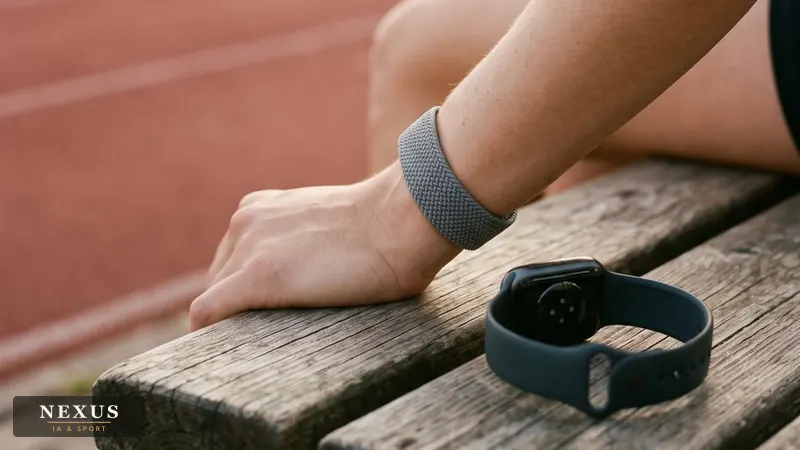
For a decade, wearables competed on bigger and brighter screens. Now the screen is disappearing. Garmin, Google and Polar all sell screenless bands, and according to Bloomberg, Apple is testing one too. This week Whoop launched a social network and Oura agreed to buy an AI-assisted primary care startup. The band on your wrist is turning into a cheap sensor. The real fight is over your health data and the subscription attached to it.
Apple is testing a screenless band
On September 22, Bloomberg’s Mark Gurman reported that Apple has spent months exploring a screenless health tracker in the spirit of Whoop. The prototypes described pair a thin fabric band with a small module packed with sensors.
Nothing is decided. Bloomberg says Apple has not committed to launching it, and if it does, a product is not expected before 2028. Tim Cook and Eddy Cue, who took over Apple’s health team, are said to back the project. The report alone knocked Garmin shares down as much as 2.5% during the session, which tells you how touchy this small market has become.
Why lose the screen?
The display is the most power-hungry part of a smartwatch. Without it, a band lasts one to two weeks instead of a day or two. It is comfortable enough to sleep in and wear in the shower, which means fuller sleep data.
There is a softer argument too. A band with no screen does not buzz at every message or tempt you to check your wrist every five minutes. Brands pitch it as a device that measures without interrupting. You look at the numbers in the phone app, usually once in the morning.
The lineup: prices and subscriptions
Whoop 5.0 and MG. The category pioneer, launched in May 2025. The band comes with the membership, from $199 a year. No membership, no data.
Fitbit Air (Google). Launched in May 2026 at $99.99, about 12 grams, up to seven days of battery. Core features are free. Google Health Premium is optional, with a three-month trial.
Garmin Cirqa. Announced July 21, 2026, at $199.99. Up to ten days of battery and rated for swimming. It tracks sleep, heart rate variability, stress and Garmin’s Body Battery, with no required subscription.
Polar Loop. Released in September 2025 at $199.90 (€179.90), eight days of battery, no required subscription. Polar sells an optional plan, just under €10 a month, for training programs.
Amazfit Helio Strap. The budget pick at $99.99 when it launched in June 2025, with ten days of battery and no subscription.
Apple. No product and no price. Only prototypes, according to Bloomberg.
What these bands actually measure
Taking the screen away does not change the sensors. You still get an optical sensor reading your pulse through the skin and an accelerometer. Some models add skin temperature. So a screenless band is not more or less accurate by design. It comes down to the model and the metric.
The research lines up with our smartwatch accuracy ranking. A 2025 study covering 536 nights found a mean error of 3% for the Whoop 4.0’s resting heart rate and 8% for its heart rate variability, against an ECG chest strap. That is fine for spotting trends. Sleep stages are another story: no band measures them directly. It infers them from heart rate and movement.
The bigger issue is that most new models have never been tested independently. A 2024 review led by Cailbhe Doherty estimated that only about 11% of wearables on the market had been validated for even one metric. The Cirqa and Fitbit Air are too new to appear in that research, like most bands released in the past year.
Oura is buying doctors
On November 10, smart ring maker Oura announced it will acquire Counsel Health for $625 million. Counsel runs an AI that handles first medical questions and can hand off to a real physician. Oura plans to build it into its app, which has around six million members.
The deal comes a few weeks after Oura shelved its stock market listing. The company is still growing fast: TechCrunch reports revenue up 153% year over year, to $533 million for the quarter ending in September.
The real fight: your data and your subscription
Put these moves side by side and the strategy is clear. The band becomes a cheap sensor. The value moves into the app: recovery scores, AI coaching, the social feed and soon medical advice. That is where subscriptions live, and subscriptions are recurring revenue.
For you, the question shifts. It is no longer only whether the band is accurate. It is who you trust with your nights and your heart, sometimes even your symptoms, and how much that costs per year. Garmin and Polar, which don’t force a subscription, are leaning hard into exactly that point.
Should you buy one?
If you mainly want to follow sleep and recovery over time, a screenless band does the job, as long as you watch trends over weeks rather than today’s score. If you want pace or heart rate in front of you on a run, a watch is still more practical.
Before you buy, add up the cost over three years, subscription included, and read what the brand does with your data. A $99 band with no subscription and a band bundled into a $199-a-year membership are very different purchases. As for Apple, nothing says it will ever ship, so do not hold your breath.
Key takeaway
Without a screen, the band is just a sensor, and the battle moves into the app: your data and your subscription. Compare the three-year cost and the data policy, not just the price of the band.
Frequently asked questions
Is Apple releasing a screenless band?
According to Bloomberg, Apple is testing prototypes but has not decided to sell one. If it goes ahead, a product is not expected before 2028.
Which screenless bands work without a subscription?
The Garmin Cirqa, Polar Loop, Amazfit Helio Strap and, for core features, the Fitbit Air. Whoop only works with a membership.
Is a screenless band less accurate than a smartwatch?
Not by design, since it uses the same sensors. Accuracy depends on the model, and many recent bands have not been tested independently yet.
What is Whoop Humans?
A social network Whoop launched on November 12, 2026, where members can choose to share sleep, recovery and workouts with friends.
Why did Oura buy Counsel Health?
To add AI-assisted medical advice to its app, with a handoff to real physicians. The $625 million deal was announced on November 10, 2026.
What is the cheapest screenless band?
The Amazfit Helio Strap and the Fitbit Air, both around $100 at launch.
Sources and method
This article draws on 10 sources, listed below. References checked in November 2026. Artificial intelligence tools help with research and writing: our method explains how. Found a mistake? Let us know and we will correct it and say so on the page. This article is for information and does not replace the advice of a doctor or sports professional who knows your situation.
- MacRumors (September 23, 2026), Apple working on a screenless fitness band, per Bloomberg
- Garmin Rumors (July 2026), Garmin Cirqa launch: price, battery, metrics
- Polar (September 2025), Polar Loop launch press release
- DC Rainmaker (June 2025), in-depth review of the Amazfit Helio Strap
- Android Central (May 2026), Google Fitbit Air launch: price and specs
- TechCrunch (November 12, 2026), Whoop launches a social network
- Gadgets & Wearables (November 12, 2026), Whoop’s $11 million auto-renewal settlement
- TechCrunch (November 10, 2026), Oura to acquire Counsel Health for $625 million
- Dial et al. (2025), validation of overnight resting heart rate and HRV in five consumer wearables (Physiological Reports)
- Doherty et al. (2024), a living umbrella review of consumer wearable accuracy (Sports Medicine)