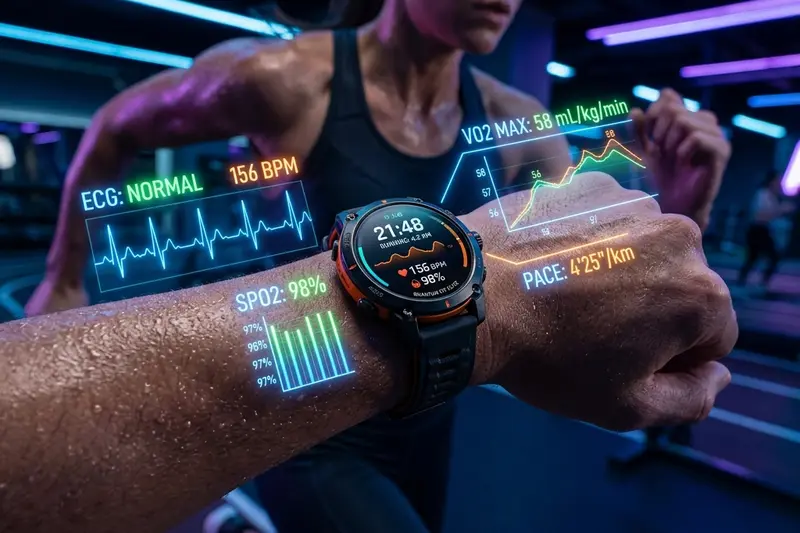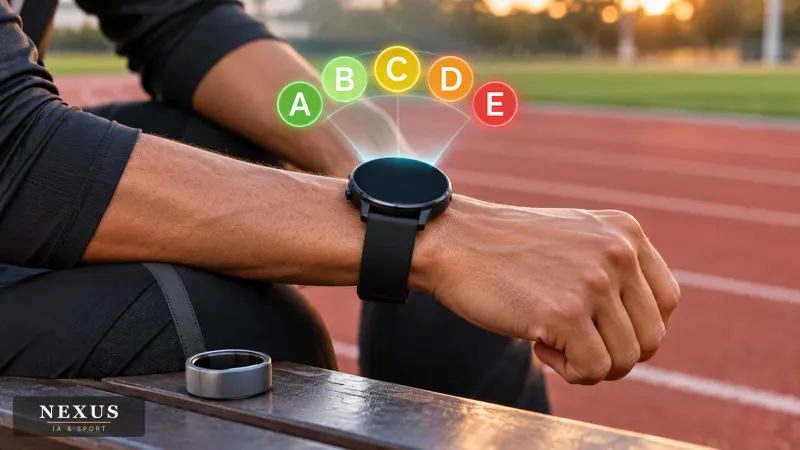
Your watch shows you twenty-odd numbers and treats every one of them as fact. Some are close to medical grade. Others can be off by a third. A 2024 review found that only about 11% of wearables on the market have been validated for even one health metric. So we went through the best available research, metric by metric, and graded what your wrist is telling you. Here is what to trust, and what to take with a large grain of salt.
The grades at a glance
A, trust it. Resting and overnight heart rate, plus irregular rhythm alerts, as long as you treat an alert as a reason to see a doctor rather than a diagnosis.
B, solid. Heart rate during exercise, step counts, overnight heart rate variability (HRV), and whether you were asleep at all.
C, ballpark. VO2 max and blood oxygen (SpO2). Good for spotting a trend, not for an exact value.
D, unreliable. Sleep stages (light, deep, REM) and activity intensity.
E, ignore it. Calories burned. No serious study supports trusting the number for any single workout.
These grades are ours. Each one summarizes published research, and every grade is explained below with its numbers and caveats. We will update this page whenever an important new study comes out.
How we graded
Our anchor is a 2024 review by Cailbhe Doherty and colleagues at University College Dublin, published in Sports Medicine. It pulls together 24 systematic reviews covering more than 200 validation studies, which makes it the broadest look yet at how accurate consumer health wearables really are. We added newer or more focused studies on sleep, HRV, VO2 max and blood oxygen.
The scale is simple. A means the average error stays under roughly 3% against the reference device (an ECG, a sleep lab, a lab treadmill test). B means up to about 10%. C means the error tops 10% or swings a lot between brands. D means the device regularly puts things in the wrong category. E means the error can exceed 20% in either direction.
One big caveat: most of this research uses healthy adults and models that are a year or two old. A newer watch may do better, or worse. And the most striking number in the Doherty review is about coverage, not accuracy. Out of 1,550 possible device and metric combinations, only 3.5% had ever been tested.
A: resting heart rate and irregular rhythm alerts
Your resting heart is where wearables shine. In a 2025 study funded by the US Air Force Research Laboratory, 13 adults were tracked across 536 nights against a Polar H10 ECG chest strap. Mean error for resting heart rate was 1.7 to 1.9% for the Oura rings, 2.7% for the Polar Grit X Pro and 3% for the WHOOP 4.0. The Garmin Fenix 6 could not be lined up with the reference on this metric.
Atrial fibrillation alerts also earn an A, with a footnote. The Doherty review reports pooled sensitivity of 100% and specificity of 95% for detecting AF. In the Apple Heart Study, published in 2019 in the New England Journal of Medicine with 419,297 participants, only 0.52% ever got an alert. Among those who then wore an ECG patch, AF showed up in about a third. So an alert is worth acting on, but it does not replace a doctor. We go deeper in our piece on smartwatch ECG.
B: workout heart rate, steps and overnight HRV
During exercise, heart rate holds up but slips. The Doherty review puts average bias around 3%. A 2017 Stanford study led by Anna Shcherbina found median error under 5% for most of the seven devices it tested. The trouble comes from wrist movement, a loose strap and very short efforts. For intervals, a chest strap is still the safer bet.
Step counts land between 9% under and 12% over, depending on the review. That is good enough to tell whether you walked more this week than last, not to settle which brand counts better.
HRV, the number WHOOP, Oura and Garmin use to tell you whether you are recovered, depends heavily on the brand. In the 2025 study, mean error was 6% for the Oura Gen 4, 7% for the Oura Gen 3, 8% for the WHOOP 4.0, 10.5% for the Garmin Fenix 6 and 16% for the Polar Grit X Pro. WHOOP responded in December 2025 that these gaps sit within normal day-to-day variation. Both things are true: the trend is useful, but a few points of change from one morning to the next often means nothing.
Telling whether you were asleep is something wearables do well. In a 2024 Harvard-affiliated study, the Oura ring, Fitbit Sense 2 and Apple Watch Series 8 caught 95 to 97% of sleep. Their weakness runs the other way: they are poor at noticing when you are lying awake. A 2021 study of seven devices found only 18 to 54% of wake periods correctly flagged, so total sleep time tends to be overstated.
C: VO2 max and blood oxygen
The VO2 max on your watch is not measured, it is estimated. A 2022 meta-analysis by the European INTERLIVE network found that devices estimating it during exercise beat those estimating it at rest, which tend to overshoot, with gaps of up to about 15%. Even in the best case, individual error can approach 10 ml per kilogram per minute, which is a lot.
In 2025, an Irish team compared the Apple Watch with a proper lab treadmill test in 30 people. The watch underestimated VO2 max by 6 ml/kg/min on average, a 13% error. Use your watch number to track progress over months, not to compare yourself with a friend or a lab result.
For SpO2, brands are not equal. A 2023 Duke University study tested four watches on 49 patients against a medical-grade oximeter. The Apple Watch Series 7 came closest, with a mean absolute error of 2.2 points, against 5.8 for the Garmin Venu 2s. The watches also failed to return a reading 11 to 31% of the time. For anything respiratory, a medical oximeter is the only number that counts.
D: sleep stages and activity intensity
This is the most heavily marketed feature and the least deserved. A watch cannot read brain activity, so it infers your sleep stages from movement and heart rhythm. In the 2024 Harvard-affiliated study, agreement with a sleep lab was moderate (kappa 0.55 to 0.65). The Apple Watch overstated light sleep by 45 minutes and understated deep sleep by 43 minutes a night, the Fitbit by 18 and 15 minutes. The Oura ring showed no significant gap, but the study was funded by Oura and its lead author sits on the company’s medical advisory board. We explain why that matters in our sleep tracking piece.
For activity intensity (light, moderate, vigorous), the Doherty review reports errors of 29 to 80%. Your watch’s “intense minutes” are a rough guess at best.
E: calories
It is the number people check most, and the one most likely to be wrong. In the Stanford study, none of the seven devices estimated energy expenditure well: the best was off by 27% at the median, the worst by 93%. The 2024 review finds a smaller average bias, around 3% under, but with individual errors ranging from 21% under to 15% over. In other words, for any given workout you cannot tell which way your watch is wrong.
Planning what to eat after a run based on that number is flying blind. At most, it helps compare one week with another on the same watch.
What this means for your training
Trust your watch for resting heart rate, the direction of your HRV over several weeks, and how your VO2 max moves over several months. These compare you with yourself, which is exactly where wearables are strongest.
Be wary of absolute numbers. A VO2 max of 52, 480 calories or 1 hour 40 of deep sleep are estimates. And do not let a score tell you how you feel. If your recovery score is poor but you feel great, your body is often right.
For health concerns, such as an irregular heartbeat, unusual breathlessness or badly disrupted sleep, the watch is an early warning. The answer comes from a doctor and a medical device.
Key takeaway
Your watch is reliable for resting heart rate and useful for tracking trends. It becomes a ballpark for VO2 max and blood oxygen, and unreliable for sleep stages and calories. Compare yourself with yourself, not with an absolute number.
Frequently asked questions
What is the most accurate smartwatch metric?
Resting and overnight heart rate. In a 2025 study of 536 nights, mean error stayed between 1.7 and 3% depending on the device.
Is my smartwatch VO2 max accurate?
It is an estimate. Errors run around 10 to 15%, and a 2025 study found the Apple Watch underestimated VO2 max by 6 ml/kg/min on average. Use it to track progress, not as an exact value.
Can I trust the deep sleep my watch shows?
Not for any single night. Watches infer sleep stages from heart rate and movement, and can be off by around 40 minutes of deep sleep per night.
Are calorie burn numbers reliable?
No. Errors range from 21% under to 15% over in the 2024 review, and up to 93% for some devices in the Stanford study.
Which brand is the most accurate?
It depends on the metric. Oura rings led on overnight heart rate and HRV in the 2025 study, and the Apple Watch led on SpO2 in the Duke study. No brand wins everywhere, and few recent models have been independently tested.
How many wearables have been scientifically validated?
Very few. According to the 2024 Doherty review, about 11% of devices on the market have been validated for at least one metric.
Sources and method
This article draws on 9 sources, listed below. References checked in November 2026. Artificial intelligence tools help with research and writing: our method explains how. Found a mistake? Let us know and we will correct it and say so on the page. This article is for information and does not replace the advice of a doctor or sports professional who knows your situation.
- Doherty et al. (2024), a living umbrella review of consumer wearable accuracy (Sports Medicine)
- Shcherbina et al. (2017), accuracy of seven wrist-worn devices for heart rate and energy expenditure (Journal of Personalized Medicine)
- Perez et al. (2019), the Apple Heart Study (New England Journal of Medicine)
- Dial et al. (2025), validation of overnight resting heart rate and HRV in five consumer wearables (Physiological Reports)
- Robbins et al. (2024), Oura, Fitbit and Apple Watch sleep tracking against polysomnography (Sensors)
- Chinoy et al. (2021), seven consumer sleep trackers compared with polysomnography (Sleep)
- Molina-Garcia et al. (2022), validity of wearable VO2 max estimates, INTERLIVE meta-analysis (Sports Medicine)
- Lambe et al. (2025), accuracy of Apple Watch VO2 max (PLOS One)
- Jiang et al. (2023), SpO2 accuracy of four consumer smartwatches (PLOS Digital Health)