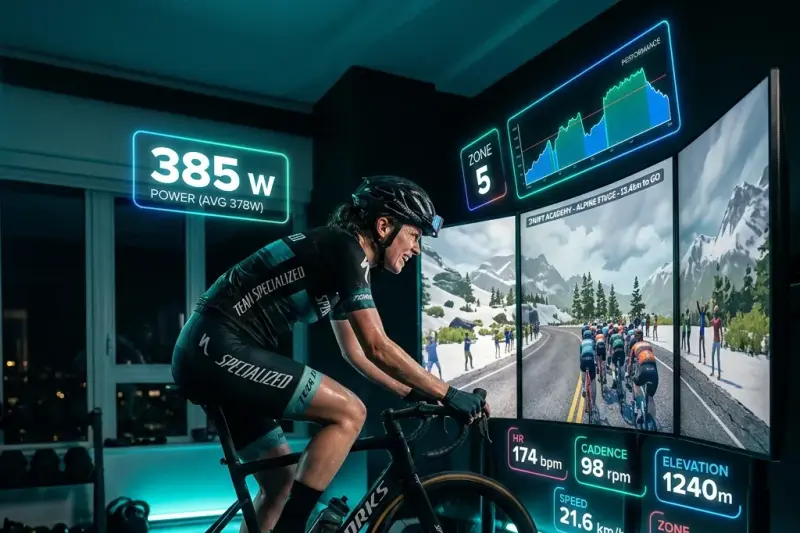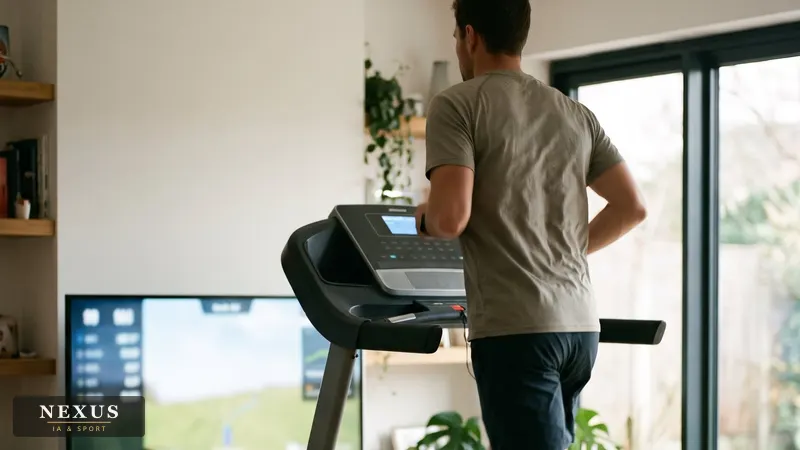
In late September, Peloton launched three new treadmills, two of them fitted with a camera that analyses how you run. Since October 1, the Run Analysis feature has been rolling out to members in supported countries. The idea is appealing: run at home and get a score on the quality of your stride at the end of the session. But what does the camera really measure? Does a score from 1 to 100 mean anything? And do you need a treadmill costing over 3,000 dollars to get these numbers? We read Peloton’s announcements and the research on running technique.
Three treadmills, two with a camera
Peloton unveiled its new range on September 22, 2026. The Tread Flex, at 2,195 dollars, is the brand’s first foldable treadmill and its cheapest. It reaches 12.5 miles per hour, about 20 km/h, and folding cuts its length by nearly half. The Tread Vision, at 3,495 dollars, adds the movement-tracking camera. The Tread+ Vision, at 6,695 dollars, keeps the camera and swaps the belt for slats, with a Sled Mode offering up to 300 pounds of resistance.
Peloton’s CEO, Peter Stern, summed up the shift: the brand wants to go “beyond the bike” and go all-in on running, walking and hiking. The timing is no accident. Run clubs are multiplying, marathons are breaking entry records, and formats like Hyrox are drawing a new crowd, with which Peloton also has a partnership.
What the camera measures
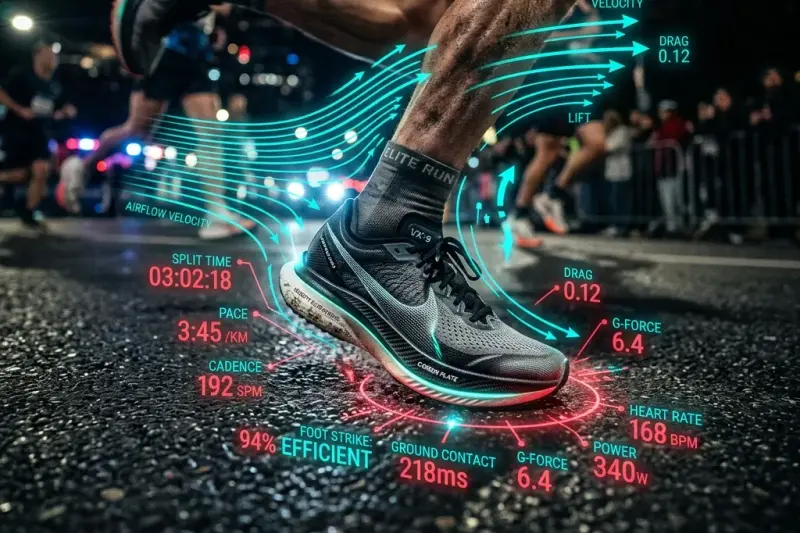
According to Peloton, the camera measures cadence in real time, meaning steps per minute, and vertical oscillation, how far your body moves up and down with each stride. It also estimates stride length. At the end of the session you get a Running Efficiency Score from 1 to 100, meant to show how well your form turns effort into forward motion, along with tips to improve.
According to Engadget, Peloton worked with a biomechanics group that specialises in running and injury prevention. But the brand does not explain how the score is calculated. We do not know how much each measure weighs, or what a 70 or an 85 means. That is the main weakness of the system: a score you cannot check is a black box.
Peloton also cites an internal study of 2,069 new treadmill users: 56% reportedly ran faster after six months. That result comes from the brand itself and says nothing about the camera specifically. Six months of regular training makes almost anyone faster, treadmill or not.
What research says about these measures
Cadence is the best-studied measure. In 2011, Bryan Heiderscheit’s team had 45 recreational runners run at a constant speed. Raising cadence by 5 to 10% clearly reduced the energy absorbed at the knee, and at the hip at +10%. It is one of the few technique tips backed by solid data, especially for runners who overstride.
For the rest, caution is needed. In a 2016 review, Isabel Moore concluded that a single economical running technique cannot be recommended for everyone. Many runners naturally settle on a stride close to the one that costs them the least energy. In other words, there is no perfect stride. A single score can push you to fix something that did not need fixing.
Then there is the treadmill itself. A meta-analysis led by Bas Van Hooren, covering 33 studies, found that most measures do not differ between treadmill and outdoor running. The differences are mainly in foot angle and knee flexion at foot strike. Advice received on a treadmill is therefore largely useful on the road, without being identical.
A watch already does part of the job
None of these measures is new. Running watches have estimated cadence from the wrist for years. With a chest strap or a small pod clipped to the waist, some Garmin, Coros or Polar models also show vertical oscillation, stride length and ground contact time, outdoors as well as on a treadmill. Those sensors cost far less than a new treadmill.
Peloton’s real difference is video. A camera sees the whole posture: torso, arms, where the foot lands. A waist pod only sees accelerations. If Peloton really used that image, with precise posture advice, the system would go further than a watch. For now, the announced measures are exactly the ones a sensor can already provide. To see which watches measure accurately, our reliability ranking compares independent studies.
What about privacy?
A camera in a living room raises a simple question: where do the images go? In the launch information, Peloton does not say whether the analysis happens on the device or on its servers, or how long the data is kept. Before buying, it is worth reading the privacy policy and checking whether the camera has a cover. Movement data from a body is personal data, as we explained in our article on athlete data.
Our take: useful for cadence, not essential
For a beginner who trains mostly at home, cadence feedback after every session can genuinely help, and it is the measure that matters most for limiting injuries. For everyone else, the price is hard to justify: a foot or waist pod and a watch already give these numbers, and they work outdoors too.
We remain sceptical about the 1-to-100 score until Peloton explains how it is calculated. A good tool shows what it measures and lets the runner judge. An opaque score mostly risks sending people after a “perfect” stride that does not exist. If you want to know what wearable scores are worth, read our investigation into recovery scores as well.
Key takeaway
The camera on Peloton treadmills measures cadence, vertical oscillation and stride length, then gives a 1-to-100 score whose formula is not public. Cadence feedback helps limit injuries, but a watch with a sensor already gives these numbers for far less.
Frequently asked questions
What does the camera on Peloton treadmills measure?
It measures cadence, vertical oscillation and stride length while you run, then gives a Running Efficiency Score from 1 to 100 with tips. The feature is called Run Analysis.
Which Peloton treadmills have the camera?
The Tread Vision (3,495 dollars) and the Tread+ Vision (6,695 dollars). The foldable Tread Flex, at 2,195 dollars, is not listed among the Run Analysis models. Run Analysis also works on the Cross Training Tread+.
Does raising cadence reduce injuries?
A 2011 study shows that raising cadence by 5 to 10% reduces loading at the knee and hip. It is one of the technique tips best supported by research.
Can a watch measure the same things?
Largely, yes. With a chest strap or a waist pod, several watches show cadence, vertical oscillation and stride length, outdoors and on a treadmill.
Sources and method
This article draws on 7 sources, listed below. References checked in November 2026. Artificial intelligence tools help with research and writing: our method explains how. Found a mistake? Let us know and we will correct it and say so on the page. This article is for information and does not replace the advice of a doctor or sports professional who knows your situation.
- Peloton (September 22, 2026), what is new in the 2026 treadmill updates, Run Analysis and efficiency score
- Athletech News (September 22, 2026), Peloton goes all-in on running, prices and Peter Stern’s remarks
- Engadget (September 2026), Peloton launches a foldable treadmill and camera-based run analysis
- Peloton investor release, launch of the Tread Flex
- Heiderscheit et al. (2011), effects of step rate manipulation on joint mechanics during running, Medicine & Science in Sports & Exercise
- Moore (2016), “Is there an economical running technique?”, Sports Medicine
- Van Hooren et al. (2020), motorized treadmill versus overground running, meta-analysis of 33 studies, Sports Medicine