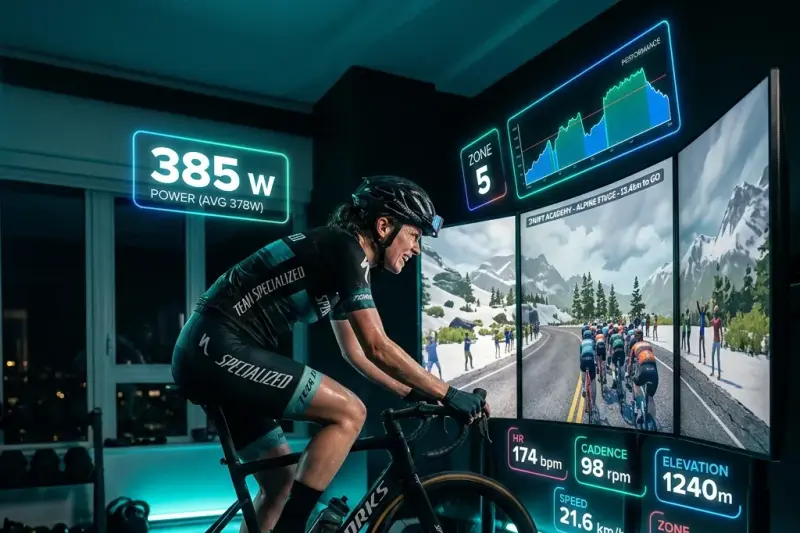
Almost every cycling app runs on a single number. You suffer through twenty minutes, knock off 5%, and that is your FTP, the figure behind every zone and interval you will ride for the next two months. It is a handy shortcut. A handful of studies show why it can also leave you blowing up on a session you were supposed to finish.
One number that everything hangs on
FTP means functional threshold power: the highest power you can hold fairly steadily for about an hour. Coaches Hunter Allen and Andrew Coggan popularised it in the early 2000s.
Your zones, your interval targets and your training load are all percentages of it. If it is wrong, your whole plan is off.
Why the shortcut exists
Nobody wants to ride flat out for an hour, let alone repeat it. So you test for twenty minutes and take 95%. It is simple and nearly every platform offers it.
The catch is that 95% is an average. Whether you are explosive or more of a diesel changes the gap between twenty minutes and an hour.
The Brazilian study: right on average, wrong for individuals
In 2018, Felipe Borszcz and colleagues gave 23 trained cyclists a lab ramp test, a 20-minute time trial and a 60-minute one. On average the 95% rule landed within a few watts of true one-hour power.
Rider by rider, though, the gap could reach forty or even sixty watts. Asked to ride at their estimated FTP until exhaustion, they lasted 51 minutes on average, with differences of a quarter of an hour either way. The authors concluded that the two measures are not interchangeable for an individual.
The Canadian study: try 90%
In 2019, Martin MacInnis and colleagues at McMaster University tested eight highly trained cyclists. The 20-minute test was very repeatable, with barely 5 watts between attempts, which is good news for anyone using it to track progress.
They averaged 342 watts for twenty minutes and 309 for an hour. That is about 90%, not 95%, so the usual rule would have overstated their FTP by around fifteen watts.
Why fifteen watts ruins your Tuesday
Overestimate FTP by 5% and a threshold session is suddenly above threshold. You crack before the end, decide you are out of form, or pile up fatigue you never planned. Underestimate it and your sessions are too easy.
Apps that adjust FTP according to sessions you complete or fail fix some of this. They still start from an estimate, and their algorithms are not published in any detail.
Check yours on the road
After your test, ride two blocks of twenty minutes at the estimated FTP. If you cannot finish, it is too high. If it feels easy, it is probably too low.
Watch perceived effort and heart rate on regular rides as well. No single number beats a few weeks of paying attention.
FTP or critical power?
Researchers often compare FTP with critical power, an older physiological idea. In the Canadian study, critical power from 4- and 20-minute tests was also strongly tied to one-hour power. A 2021 study of 17 trained cyclists and triathletes compared the two directly. Critical power averaged 7 watts above FTP, but depending on the rider the gap ran from 19 watts below to 33 watts above.
Both describe roughly the same line, between efforts you can sustain and efforts that quickly finish you. Neither one is perfect.
Who these studies leave out
Both are small and involve trained men, so the results may not apply to women, beginners or older riders. Data on those groups are still missing. A 2021 review of the literature says the same: it found only fifteen studies of the 20-minute test, most of them on trained male cyclists.
The main point stands anyway. The test is reliable for tracking your form. The conversion to one-hour power is something every rider should check for themselves.
Key takeaway
The 20-minute test is a good way to track your form. The 95% rule is an average, so check it on the road before you trust it.
Frequently asked questions
What is FTP?
The highest power a cyclist can hold steadily for about an hour.
Should you take 5% off the 20-minute test?
It is a good average, but the real gap varies widely between riders. In a Canadian study it was closer to 10%.
Is the 20-minute test reliable?
Yes for following progress: two successive tests give very close results. The conversion to one-hour power is less certain.
How long can you hold your FTP?
In the 2018 study, riders held their estimated FTP for 51 minutes on average, with big differences between them.
How do I check my FTP?
With a session of two times 20 minutes at the estimated value. If it is impossible or too easy, adjust.
Sources and method
This article draws on 4 sources, listed below. References checked in November 2026. Artificial intelligence tools help with research and writing: our method explains how. Found a mistake? Let us know and we will correct it and say so on the page. This article is for information and does not replace the advice of a doctor or sports professional who knows your situation.
- Borszcz et al. (2018), validity of functional threshold power (International Journal of Sports Medicine)
- MacInnis et al. (2019), reliability of 4- and 20-minute tests and the link with FTP (International Journal of Sports Physiology and Performance)
- Karsten et al. (2021), critical power and the 20-minute FTP test (Frontiers in Physiology)
- Mackey and Horner (2021), what is known about the 20-minute FTP test, scoping review (Journal of Sports Sciences)