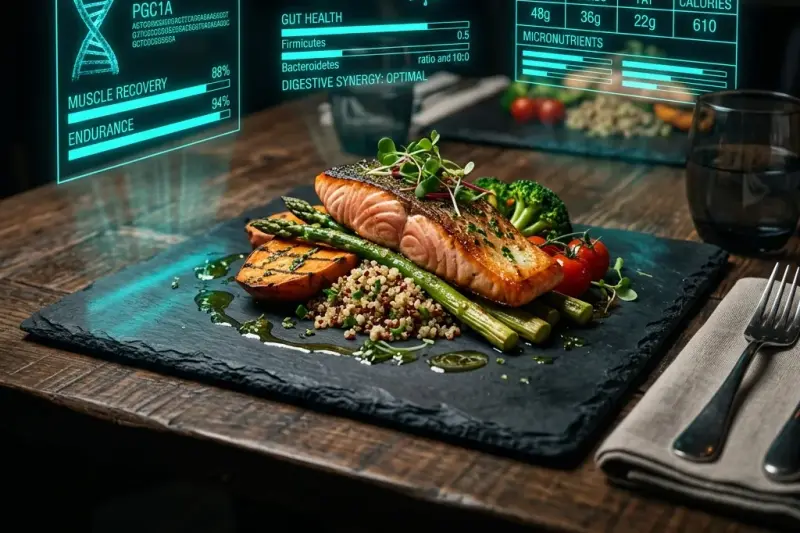
Give two people the same food and their blood sugar can respond very differently. That finding is real, and a whole industry of apps, glucose sensors and supplement plans has been built on top of it. Some of that structure stands on solid ground. A lot of it does not.
Where personalised nutrition came from
In 2015, a Weizmann Institute team led by David Zeevi tracked the blood sugar of 800 people continuously for a week. Responses to the same food varied enormously from person to person.
An algorithm using the microbiome and blood tests, among other things, predicted those reactions better than simple carbohydrate counting. That paper is the scientific root of everything the apps now promise.
Why that is only a small part of an athlete’s problem
Blood sugar after a meal barely scratches what matters in sport. The first questions are whether you are eating enough for your training load and whether you recover well.
A framework already exists. Carbohydrate needs run from about 3 grams per kilo of body weight a day on light days to 10 grams or more for big endurance volumes. Protein sits between 1.2 and 2 grams per kilo a day. Personalising inside those ranges makes sense. An app that strays far outside them, for example by stripping nearly all carbohydrate from an endurance athlete, should make you suspicious.
The dangerous mistake is eating too little
The International Olympic Committee has been warning for years about relative energy deficiency in sport. When you eat too little for your training, the body starts cutting back: hormones go wrong, bones weaken, injuries become more frequent, and in women periods can stop.
It is not only a problem in weight-category sports. A tool that nudges you to keep eating less, or turns every meal into a score, can make a problem worse before anyone has noticed it exists.
Glucose sensors: useful, and easy to misread
Continuous glucose monitors were built for people with diabetes. In a healthy athlete, a rise after a carb-heavy meal is normal, and a spike on the graph is not a warning sign.
During exercise the reading can also lag behind your blood, because the sensor samples fluid under the skin. They can teach you about your own responses, but you want someone beside you who knows how to interpret them. They do not replace a dietitian who knows your sport and your calendar.
Almost no supplements have earned their claims
The IOC’s 2018 consensus, led by Ron Maughan, is blunt. Only a handful have solid evidence for performance, such as caffeine, creatine and bicarbonate, and only in certain situations.
It also warns that supplements can be contaminated with banned substances. An app recommending five capsules a day to a drug-tested athlete is putting their career at risk.
Photo calorie counters
Some apps estimate a meal from a picture. It is a neat idea with obvious limits: the camera cannot see the oil, the sauce under the meat or what went into a mixed dish.
They can make you more aware of your habits. If you need to hit precise intakes, weigh your food or work with a dietitian.
The cheapest personalisation there is
Weigh yourself before and after a session. One kilo lost is roughly one litre of sweat. Then drink about one and a half times that over the following hours, with a little salt if the session was long and hot.
That is genuine individual tailoring, and all it takes is a set of bathroom scales.
How to judge an app in two minutes
Ask who designed the advice and whether a sports dietitian was involved. Ask which studies the algorithm rests on, whether the company also sells supplements, and what happens to your health data.
A good app helps you log food, track how you feel and plan meals around sessions. One that promises to “unlock” your performance with a secret programme is mainly selling the promise.
PREDICT, the large study on meal responses
The PREDICT 1 study, published in 2020 in Nature Medicine, followed 1,103 healthy adults, including 660 twins, for two weeks. For the same meal, blood sugar, insulin and blood fat responses varied up to tenfold from one person to another. Genes explained only a small part of it, even in identical twins.
Two caveats before treating it as proof for the apps. PREDICT is an observational study, not a trial showing that a personalized diet works better. And one of its authors, Tim Spector, co-founded ZOE, the company that sells a test based on this work. It is the same reflex as for smartwatch metrics: check who ran the study, and what it really proves.
Key takeaway
Personalisation is useful for understanding your own reactions. It is no reason to buy supplements that have no evidence behind them.
Frequently asked questions
Is a glucose sensor useful for a healthy athlete?
It can help you understand your reactions to certain meals, but the data are hard to interpret alone. It is not an essential tool.
How do I choose a supplement without a doping risk?
Favour products tested under a standard designed for athletes, such as the AFNOR NF V94-001 standard in France, and talk to your doctor.
How much protein a day for an athlete?
Recommendations range from 1.2 to 2 grams per kilo of body weight per day, spread over several meals.
What should I eat during a long effort?
For efforts of more than an hour, 30 to 60 grams of carbohydrate an hour, and up to 90 grams for very long events with suitable products and a trained gut.
How much should I drink after a session?
About one and a half times the weight lost during exercise, spread over the following hours.
Can an AI build my meal plan?
It can offer a starting point and meal ideas. For an athlete with precise goals or health constraints, a sports dietitian is still needed to adjust and follow up.
Is creatine safe?
In healthy adults at usual doses, it is among the best-studied supplements. Choosing a tested product remains important for athletes subject to anti-doping controls.
Sources and method
This article draws on 6 sources, listed below. References checked in November 2026. Artificial intelligence tools help with research and writing: our method explains how. Found a mistake? Let us know and we will correct it and say so on the page. This article is for information and does not replace the advice of a doctor or sports professional who knows your situation.
- Zeevi et al. (2015), personalised nutrition and glycaemic response (Cell)
- Maughan et al. (2018), IOC consensus on dietary supplements (BJSM)
- Thomas et al. (2016), nutrition and athletic performance, joint position statement (Medicine & Science in Sports & Exercise)
- Mountjoy et al. (2023), IOC consensus on relative energy deficiency (BJSM)
- Berry et al. (2020), individual responses to meals, PREDICT 1 study (Nature Medicine)
- King’s College London (2020), why one-size-fits-all diets don’t work