Cycle-syncing is everywhere: a different session for each phase, an app to tell you which day you are on, and a neat four-part month. It sounds sensible. The trouble is that when researchers pooled the evidence, they found a tiny effect, and one that changes a great deal from one woman to the next.
The biggest review found almost nothing
In 2020, Kelly McNulty and colleagues pooled 78 studies of women with regular cycles. Performance may be slightly lower at the very start of the follicular phase, during menstruation. The gap was so small that the authors called it trivial, and they rated the quality of evidence as low. They advised against general rules by phase and suggested looking at each athlete individually.
That does not mean the cycle changes nothing. Many sportswomen have days when everything is harder, because of pain, poor sleep or digestive trouble. That is real. Those days simply do not land at the same time or with the same force for everyone, so an average wipes them out.
Why the studies are such a mess
Much of the research works out the phase by counting days since the last period, with no hormone test. But two 28-day cycles can ovulate on different dates, and some cycles do not ovulate at all.
In 2021, Kirsty Elliott-Sale and her team published guidance on fixing this: confirm the phase with a blood or urine test, and do not lump women on hormonal contraception together with those who are not. The lesson for any club is short. A calendar does not measure hormones.
If you use the pill
Many sportswomen use hormonal contraception, which changes the hormonal profile and sometimes the symptoms. A programme built on the phases of a natural cycle makes no sense for someone on a continuous pill.
Here again, tracking how you actually feel beats any theoretical calendar.
Where tracking and AI can help
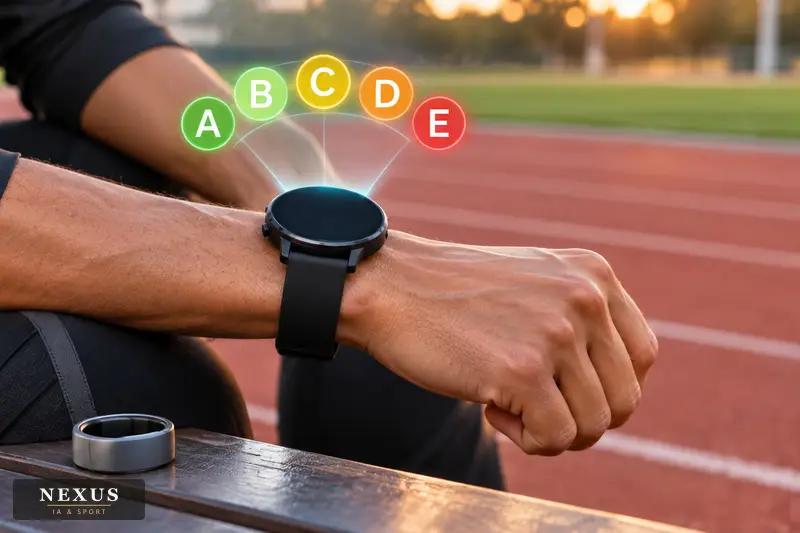
An algorithm is more useful for one person than for a rule covering everyone. Log your symptoms and daily form for several months alongside your training, and a model can find patterns of yours that a population average would hide. That is the individual approach researchers recommend.
Keep two limits in mind. The phase an app shows is a prediction, especially if your cycle is irregular. And this is some of the most sensitive health data there is. A club needs to say who can see it and guarantee that an athlete can stop sharing it with no effect on selection.
The one signal nobody should ignore
When periods stop, staff should worry. In a sportswoman not on hormonal contraception, several months without a period often means she is eating too little for her training.
The International Olympic Committee calls this relative energy deficiency in sport. It weakens bones and raises the risk of stress fractures, and a cycle app can help catch it early if somebody takes it seriously. Very severe period pain deserves a doctor’s attention too.
ACL injuries: still an open question
Anterior cruciate ligament ruptures are clearly more common in women than men in football and handball. Researchers are looking at anatomy, landing technique, fatigue and access to physical preparation.
The role of cycle hormones has been debated for a long time with no clear answer. Meanwhile, warm-up and strength programmes that work on landing and changing direction have proved themselves.
Small changes that need no technology
Being able to mention your cycle to staff without embarrassment. Toilets within reach during long sessions. Kit you feel comfortable in: in 2023, Wimbledon let players wear dark undershorts beneath the compulsory white.
These things change an athlete’s daily life, and they make it easier to adapt a session on the day it is needed.
Key takeaway
The cycle is worth tracking, one athlete at a time. An app that divides your month into four programmes promises more than science knows.
Frequently asked questions
Should training be reduced during menstruation?
Not as a matter of principle, since average data do not justify it. If an athlete feels worse on certain days, adapt for her, as you would after a bad night or with pain.
Are cycle tracking apps reliable for planning sessions?
They are useful for recording symptoms and seeing trends over several months. The ovulation date they show is an estimate, unless it is based on a hormone test.
Is it normal for a sportswoman to have no periods?
No. Apart from contraception, she should see a doctor, because it often signals an energy shortfall that weakens the bones.
Can apps predict difficult days?
After several months of notes, they can show trends specific to each athlete. They predict nothing with certainty.
Should you talk to your coach about your cycle?
Nothing requires it. But in a climate of trust, talking about it lets you adapt a session on a hard day, as you would after a bad night.
Is very severe period pain normal?
No. Pain that prevents you from training or living normally should be seen by a doctor or gynaecologist.
Sources and method
This article draws on 3 sources, listed below. References checked in October 2026. Artificial intelligence tools help with research and writing: our method explains how. Found a mistake? Let us know and we will correct it and say so on the page. This article is for information and does not replace the advice of a doctor or sports professional who knows your situation.