Ask anyone what makes a sprinter fast and they will tell you about quick legs. It is a reasonable guess, and it is mostly wrong. The difference between a good club runner and a very fast one is decided in the tenth of a second the foot spends on the track, not in the air.
The treadmill test that flipped the question
In 2000, Peter Weyand and his Harvard colleagues put 33 people on a treadmill with a force plate and had them run flat out. Top speeds ranged from 6.2 to 11.1 metres a second. The team measured how long each runner took to swing the leg forward, and how hard they hit the ground.
Swing time barely changed from slowest to fastest. Force did: the quickest runner applied about 1.26 times as much as the slowest, relative to body weight. Fast legs turned out not to be the story. Fast runners put more force down in less time.
Force is wasted if it points the wrong way
Eleven years later Jean-Benoît Morin, Pascal Edouard and Pierre Samozino added a twist. Testing twelve active men, two of them sprinters, on an instrumented treadmill and then over 100 metres on a track, they found that total force did not explain performance.
What mattered was how much of it went forwards during the acceleration. Two equally strong runners can post very different times if one of them is pushing too much towards the sky. They called this force application technique, and the encouraging part is that technique can be trained.
What the Bolt footage tells us
Krzysztof Maćkała and Antti Mero worked through television footage of Usain Bolt’s three best races: 9.69 in Beijing in 2008, 9.58 in Berlin in 2009 and 9.63 in London in 2012. Over some 10-metre stretches he was going faster than 12 metres a second.
His stride was around 20 centimetres longer than his rivals’, which paid off most in the second half of the race. Height explains a lot of that. But a long stride only helps if you can keep turning it over, and that takes huge force on every contact. Bolt, in other words, fits Weyand’s result rather than breaking it.
You no longer need a lab
Force plates cost a fortune and do not bolt onto a club track. Samozino’s group found a way round that, showing that a sprinter’s force-velocity profile can be estimated from a speed curve alone, taken from a radar or timing gates.
Then the phone arrived. In 2017, Natalia Romero-Franco and her colleagues timed twelve well-trained sprinters over 40 metres with gates, a radar and an iPhone app filming in slow motion, all at once. The phone’s times and profiles matched the reference kit almost perfectly. A tripod and an app can now tell a coach whether an athlete lacks force out of the blocks or speed late in the acceleration.
Where AI helps, and where to distrust it
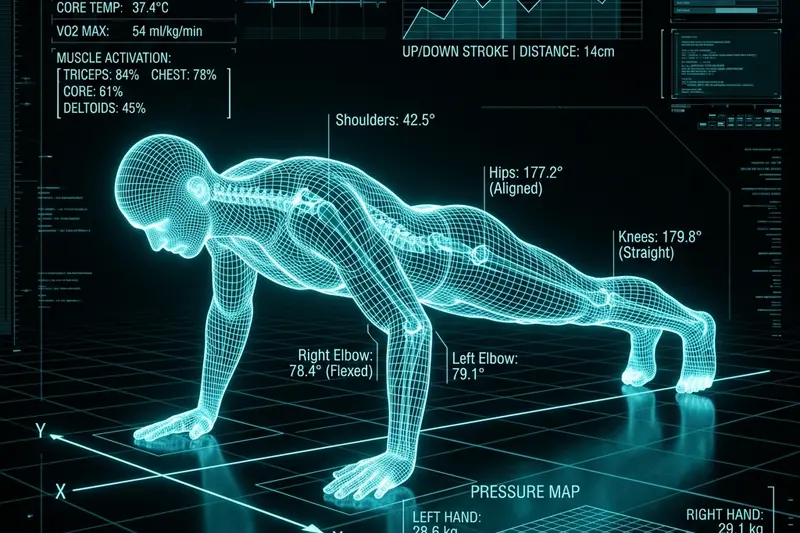
Newer software finds joints on ordinary video with no markers on the skin, then calculates hip, knee and ankle angles for every stride. That used to take hours by hand and now takes seconds.
Be careful how much you read into it. A foot on the ground for a tenth of a second gives you only a handful of frames, even at high speed, and a few degrees of error can flip a conclusion. These tools are good at comparing an athlete with themselves from one session to the next. They are much weaker at settling which of two similar techniques is better.
What to do with this on Tuesday night
If you coach, the takeaway is that speed is built with force applied quickly and forwards. Hill sprints, weighted sleds and plyometrics all train that. They do not speed up your legs. They teach the body to push harder in a very short contact.
A force-velocity profile tells you where to spend the time. Someone short of horizontal force out of the blocks needs different work from someone who fades after 40 metres. Without a measurement, everyone does the same session and you hope for the best.
Treat these numbers with some care
Most of these studies are small, mostly male and often on treadmills, which is not quite the same as running on a track. Do not assume they transfer neatly to a junior girl or a masters athlete.
One test also tells you very little. Wind, fatigue, the surface and the warm-up all move the numbers. The value comes from repeating the same test in the same conditions through a season.
And that 9.58?
Bolt’s record has stood since 2009. Nobody knows where the human limit sits, and models claiming to calculate it rest on shaky assumptions. What biomechanics can say is where any improvement has to come from: a bit more force, pointed better, in a slightly shorter contact.
For most sprinters the target is not the record but a tenth off their own best. At least now you can look for it in the right place.
Key takeaway
Speed comes from force on the ground, pointed forwards. A phone and regular testing are now enough to find out what a sprinter is missing.
Frequently asked questions
Should sprinters work on stride frequency?
Weyand’s measurements show leg swing time varies little between slow and fast runners. Force on the ground makes more difference.
What is a force-velocity profile?
A picture of the force an athlete produces at low speed, out of the blocks, and at high speed, late in the acceleration. It shows which quality to work on first.
Can a phone app really measure a sprint?
A 2017 study found close agreement between an iPhone slow-motion app and timing gates or radar, provided you film the same way every time.
Is AI video analysis accurate enough?
It is good for tracking one athlete over time. For comparing two similar techniques, the error on angles is often too large.
Why was Usain Bolt so fast?
His height gave him a stride about 20 centimetres longer than his rivals’, and he produced enough force to keep a high frequency with it.
Sources and method
This article draws on 4 sources, listed below. References checked in October 2026. Artificial intelligence tools help with research and writing: our method explains how. Found a mistake? Let us know and we will correct it and say so on the page. This article is for information and does not replace the advice of a doctor or sports professional who knows your situation.
- Weyand et al. (2000), top speed depends on the force applied to the ground (Journal of Applied Physiology)
- Morin et al. (2011), force application technique and sprint performance (Medicine & Science in Sports & Exercise)
- Maćkała and Mero (2013), kinematic analysis of Usain Bolt’s three best 100 m races (Journal of Human Kinetics)
- Romero-Franco et al. (2017), measuring a sprint with an iPhone app (European Journal of Sport Science)