Great players seem to see a pass before it exists. Tests, strobe glasses and tablet apps now promise to measure that gift and sell it back to you. The research offers one genuinely interesting finding and a large warning sign next to it.
The link is real. The direction is not known
A team led by M. Yang combined 22 studies of 1,113 team sport athletes across basketball, football and volleyball. The strongest link was with tracking several moving objects at once: players who do best at it tend to perform best in their sport.
The correlation was clear, around 0.54. But a correlation cannot tell you which came first. Good players may have built this ability by playing, rather than the other way round.
Hundreds of papers, few reach the pitch
In 2021, Daniel Laby published a critical review of vision in sport. He found hundreds of articles and very few connecting visual tests to statistics from real matches.
So be careful with training programmes. Getting better at a test does not prove you are getting better at the game.
What the tests and gadgets involve
In the multiple object tracking test, popularised by Jocelyn Faubert in Montreal, you watch identical balls moving on a screen, follow the few that were highlighted, and the speed rises as you succeed. Professional teams in several sports use it, and it does measure a real ability.
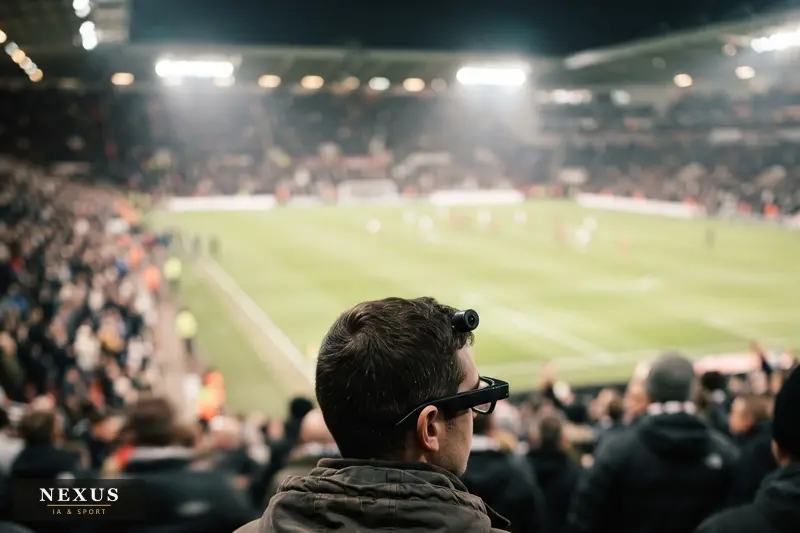
The market also offers strobe glasses that cut your vision on and off, and reaction apps on tablets. Athletes clearly improve at these tasks in the lab. Whether that shows up in matches is the question, and few studies truly check. Treat them as extras, never at the cost of real playing time, which is still the best training for reading a game.
Scanning: the version you can measure in a real game
Geir Jordet, a Norwegian researcher, filmed top midfielders and counted the small head movements they make to look around before receiving the ball. Those who scan most often generally complete more forward passes.
It is measured in real play, which makes it far more convincing than a score on a screen.
How to train it without buying anything
Put coloured markers behind a player and have them call out the colour you hold up just before the pass arrives. Keep the link with a decision, because looking without using what you saw is pointless.
You can also film a game situation, ask the player what they were looking for and compare a few repetitions. Gaze tracking shows where someone’s eyes went, not what they understood, and it should help people learn. It should never put a label on a young player.
Check the eyes first
Before any visual training, make sure the athlete can see properly. Mild short-sightedness or a difference between the eyes often goes unnoticed, particularly in young players.
A check-up with an eye specialist can fix in days what no programme will touch, and it is the cheapest step on this list.
If your club wants to try it
Start small. Take a group of players, pick something you can see in matches, such as scans before receiving, and follow it for a few weeks.
If that rises along with test scores, keep the tool. If it does not, you have avoided paying for a promise. Either way, you will have spent weeks talking to players about what they look at, and that may be the most useful part.
Key takeaway
The best players track several things at once better than others. Nobody has yet proved that a lab exercise will turn you into one of them.
Frequently asked questions
Can a visual test be used to recruit a player?
It can provide one piece of information among others, but it should never decide a selection on its own.
Do visual training glasses make you better?
The evidence varies with exercises and sports. Transfer to competition has to be checked, not assumed.
What is “scanning” in football?
The quick head movements a player makes to look around before receiving the ball.
Should young athletes have their eyesight checked?
Yes, a regular eye check is useful. An uncorrected problem can hamper reading the game without anyone noticing.
Are stroboscopic glasses dangerous?
For most athletes, no. They are not advised for people prone to photosensitive epilepsy, and it is best to use them under supervision.
What is NeuroTracker?
A training tool based on tracking several balls moving in three dimensions, derived from Jocelyn Faubert’s work at the University of Montreal.
Can peripheral vision be trained?
Some abilities linked to visual attention improve with training. Transfer to real play remains to be checked for each programme.
Sources and method
This article draws on 3 sources, listed below. References checked in October 2026. Artificial intelligence tools help with research and writing: our method explains how. Found a mistake? Let us know and we will correct it and say so on the page. This article is for information and does not replace the advice of a doctor or sports professional who knows your situation.
- Yang et al. (2026), visual skills and performance in team sports, meta-analysis (Frontiers in Physiology)
- Laby and Appelbaum (2021), vision and on-field performance, critical review (Optometry and Vision Science)
- Faubert (2013), learning complex visual scenes in professional athletes (Scientific Reports)