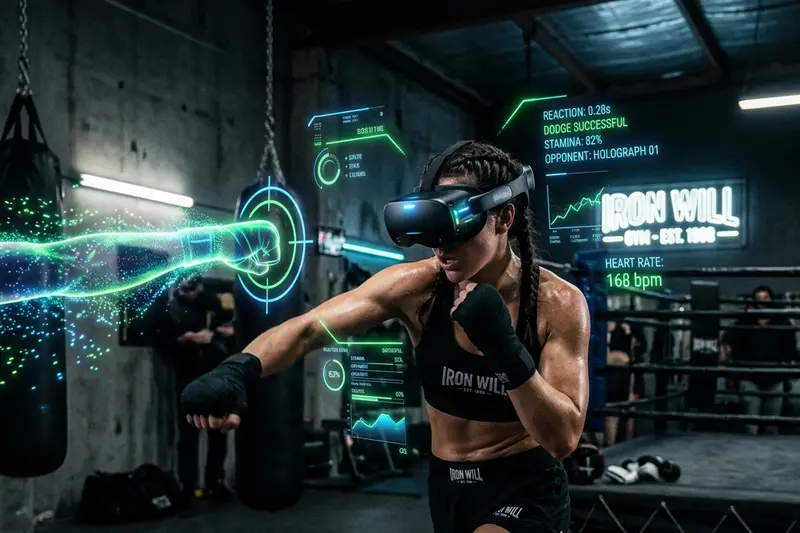
A quarterback can read a defence fifty times in a headset without taking a single hit. A goalkeeper can face the same striker all afternoon. Virtual reality is a brilliant way of repeating a decision. The awkward question is whether the player who improves in the headset has improved at all when it matters.
Six trials in ten years
In 2025, Ida Cariati and colleagues looked for randomised trials of VR in athletes and kept six from a decade of publishing. Five found a benefit, on balance, sprinting, jumping, reaction time or certain technical skills. One found nothing.
Only one of those was very high quality on the authors’ scale. That is a promising start and nowhere near proof.
The field’s biggest weakness
Stefan Michalski’s team examined 448 articles in 2019 and found only four that really measured transfer to real sport. A few studies have done it. In basketball, varsity players watched the same plays on a screen or in a headset and were then tested on court: both groups improved on the plays they had trained, but only the VR group also improved on new ones. In baseball, a trial with 80 players found that virtual batting practice adapted to each player improved real hitting.
A staff can fix that for themselves. Choose something you can observe, such as pass selection or decision time, then watch for the same situation in training. A player can get better in the headset without getting better at the game, and this check is the only way to find out.
Why decisions can be trained at all
Sports scientists call them perceptual-cognitive skills: picking out useful information, anticipating and choosing fast. They often separate experts from good players more than physical gifts do.
The key principle is representative design. An exercise has to carry the same information as competition, or the player learns to read a situation that does not exist.
Copy the decision, not the scenery
A good scenario gives the athlete something to spot and something to decide. For a goalkeeper, reading a trajectory. For a midfielder, checking their shoulder before the ball arrives.
Pretty graphics matter less than realistic pressure. If the time allowed or the cost of a mistake feels nothing like a match, you have built a reflex game. The software counts for more than the headset, too: a scenario based on a real match decision on a cheap consumer device beats expensive hardware running generic drills.
Who is using it now
American football was an early adopter. Several NFL teams worked with STRIVR so quarterbacks could rehearse reading defences with no risk of being tackled. Goalkeepers now work on reading shots, and baseball hitters on recognising pitches.
They share one feature: a fast decision made from visual information.
The drawbacks
Some users get simulator sickness, with nausea and headaches. More subtly, a player who does brilliantly in the headset may think they are ready when the real thing is faster and messier.
Cost matters as well. Realistic scenarios take time and money, and for many clubs well-used match video already delivers much of the benefit.
A session worth running
Start from a problem you have seen in matches. Say your midfielder keeps receiving with their back to play and no idea where the pressure is. Build that scene with a realistic time limit, give feedback on each choice, then recreate it in team training.
Trials tend to use ten to twenty minutes, two or three times a week, for a few weeks. Beyond that nobody has shown a benefit, and time in the headset is time taken from something else.
A quiet use during injury
Practitioners often mention one more use. A player who cannot run can still rehearse reading situations without loading the joint, in agreement with the medical staff.
The evidence here is limited, but the logic fits what we know about learning. It also keeps an injured player involved instead of leaving them alone in the gym.
Key takeaway
A VR headset is a good rehearsal tool. The proof that it works will always be found on the pitch.
Frequently asked questions
Does virtual reality replace the pitch?
No. It complements a session by repeating a reading or decision situation.
How can you tell whether a VR session works?
By following an indicator chosen in advance and checking how it changes in a real game situation.
What is representative design?
The principle that an exercise must reproduce the information and constraints of competition for learning to transfer.
Is VR suitable for team sports?
Yes, for precise individual decision situations. Reproducing a whole team game remains much harder.
Does virtual reality help during an injury?
It can let you keep working on reading the game without loading the injured area, always in agreement with the medical staff.
Which VR headset should I choose for sport?
The headset matters less than the software. A well-designed scenario reproducing a real match decision on a consumer headset beats high-end hardware with generic exercises unrelated to your sport.
Does virtual reality improve reaction time?
Some trials find progress on reaction tasks. The most important thing is to check that this progress shows up in real situations in your sport, which few studies measure.
Sources and method
This article draws on 4 sources, listed below. References checked in November 2026. Artificial intelligence tools help with research and writing: our method explains how. Found a mistake? Let us know and we will correct it and say so on the page. This article is for information and does not replace the advice of a doctor or sports professional who knows your situation.
- Cariati et al. (2025), virtual reality and sports performance, review of randomised trials (Frontiers in Sports and Active Living)
- Michalski et al. (2019), transfer from virtual environments to real sport (Frontiers in Psychology)
- Pagé, Bernier and Trempe (2019), video, virtual reality and decision-making in basketball (Journal of Sports Sciences)
- Gray (2017), transfer of training from virtual to real baseball batting (Frontiers in Psychology)