Strap on a headset and you can return serves in your living room. It is great fun, and the sales pitch writes itself. The research is another matter: when a team went looking for every study on virtual reality in tennis over five years, they found eleven.
A young field with little to show
A 2026 review in Frontiers in Virtual Reality searched for studies on VR in tennis from 2021 to 2026 and kept just eleven. They covered four areas: fitness, reading the game, motivation, and transfer to the real court.
Transfer is the one that matters. In 2019, Stefan Michalski and colleagues looked across all sports and found 448 articles, of which only four really measured whether virtual training improved real performance. The results were promising, but four studies is not many. Baseball offers a good example: in a 2017 trial with 80 players, virtual batting practice that adapted its difficulty to the player improved hitting on the field.
Why your swing will not benefit
A virtual ball has no weight, the controller does not jolt on impact, and you are not really running. You are also holding something lighter than a racket, so the automatic movements you build may not match the ones you use on court.
So VR mostly trains reading. It does little for technique.
Where it might genuinely help
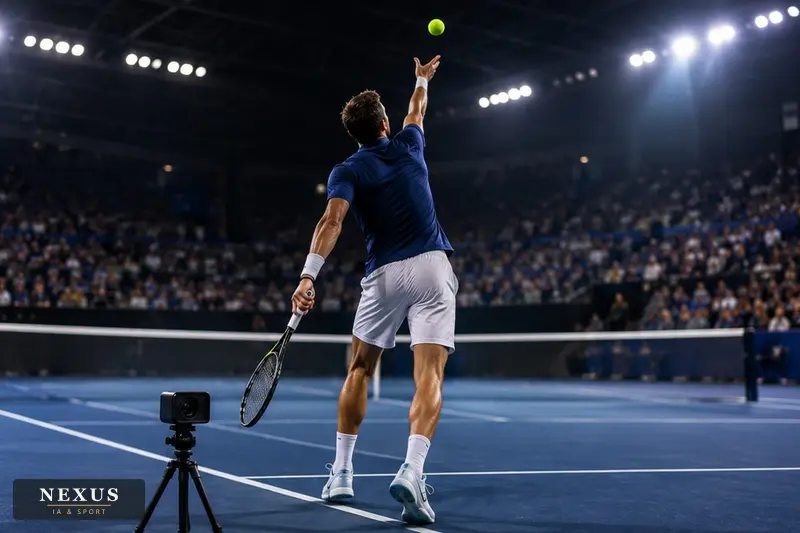
Great returners read the server before contact. The ball toss and the turn of the shoulders and racket all give clues about direction. Researchers have long studied this by cutting videos just before impact. In 2002, junior players who practised predicting serve direction from videos cut off before impact improved on court, though the gain had gone a month later without further practice.
A headset can recreate that drill in three dimensions with a life-size opponent. That is probably its best use in tennis: learning to pick up the right cues earlier.
Test it like a scientist
Otherwise you risk just getting good at a video game. Pick one measurable thing on court, such as successful returns in a series. Do two or three short VR sessions a week focused on reading serves. After a month, repeat the test in the same conditions.
If nothing changes, stop or change the drill. That is the only way to know if the headset is doing anything for you.
Keep sessions short, because lag can cause nausea in some people. Even a small delay between head movement and image can do it, and it is known as simulator sickness.
Cheaper ways to train the same skill
Programmable ball machines, a coach who deliberately mixes up serves, or videos of opponents paused before impact all train anticipation, with a real racket in your hand.
The headset has its appeal, but it is competing with simple tools that already work.
What the pros are doing
At the top level, mental preparation is taking up more time. Many players work with mental coaches on routines between points and on holding focus through long matches.
VR can fit in there, rehearsing a match point in a setting that feels like a big court. For most professionals it is one tool among many, not a pillar of their preparation.
The free version has been around for decades
Long before headsets, athletes used mental imagery: picturing a shot or a match situation in detail with their eyes closed. Sports psychology has studied it at length, and it is widely used in tennis.
If you are a club player curious about VR, start there. A few minutes before a match, picturing your serve and your first points, costs nothing.
Key takeaway
VR has potential for reading the game in tennis. For now, it is up to you to check on court that it is working.
Frequently asked questions
Can VR improve my serve?
It is unlikely: the movement needs a real ball and a real racket. It is more useful for working on reading the opponent.
Do the pros use it?
Some have tried it, mostly for mental preparation and anticipation. It is not yet a widespread tool.
From what age can you use a VR headset?
Manufacturers set a minimum age, usually in early adolescence. For younger children, the court remains the best place to learn.
How long should a session last?
Short sessions of about ten minutes limit eye fatigue and simulator sickness.
Does mental imagery really work?
Many sports psychology studies show a positive effect, especially when it is practised regularly and combined with real training.
Can virtual reality replace a practice partner?
No. It can help you work on reading a serve, but the rhythm of a rally, the footwork and the feel of the ball need a real court and a real partner.
Are there VR tennis games that help you improve?
Some games reproduce trajectories quite well. They can keep up enjoyment and coordination, but no effect on real level has been demonstrated.
Sources and method
This article draws on 4 sources, listed below. References checked in November 2026. Artificial intelligence tools help with research and writing: our method explains how. Found a mistake? Let us know and we will correct it and say so on the page. This article is for information and does not replace the advice of a doctor or sports professional who knows your situation.
- Ghazanfar et al. (2026), virtual reality and tennis, systematic review (Frontiers in Virtual Reality)
- Michalski et al. (2019), transfer from virtual environments to real sport (Frontiers in Psychology)
- Farrow and Abernethy (2002), training serve anticipation with video (Journal of Sports Sciences)
- Gray (2017), transfer of training from virtual to real baseball batting (Frontiers in Psychology)