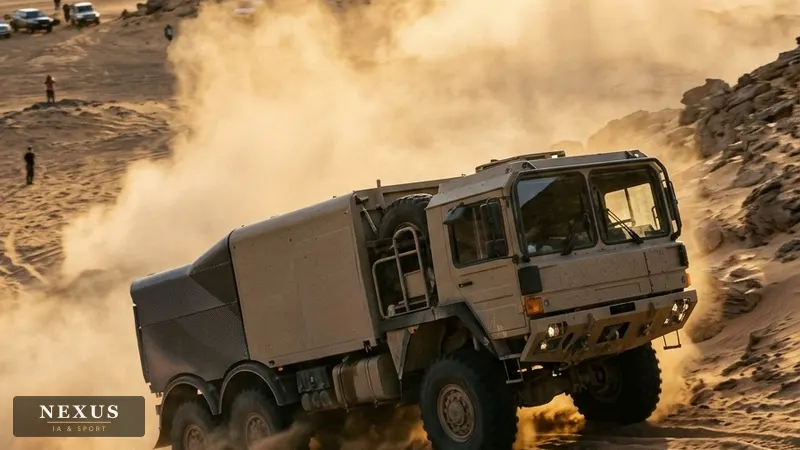
Two months before the start, the Dakar changed continents. The 2027 edition was due to run in Saudi Arabia, home of the rally since 2020. Instead it will begin in Portugal, cross the sea overnight and spend eleven stages in Morocco on the way to Marrakech. Africa is back on the Dakar map for the first time since 2007. And out in the desert, the hard work will not be done by an AI. It will be done by a navigator, a tablet and a roadbook handed over 15 minutes before the start.
The Dakar in two minutes
If you have only seen the Dakar in a few seconds of news footage, here is the short version. It is the best-known rally raid in the world: two weeks of long, timed stages across desert and rough tracks, for motorbikes, quads, cars, lightweight prototypes and trucks. It started in 1978 as the Paris-Dakar, created by the French adventurer Thierry Sabine, and it has kept the name even though it no longer goes anywhere near Senegal.
What makes it unusual is that speed alone does not win it. Competitors race on routes they have never seen, with no map and no turn-by-turn route to follow, so navigation decides as much as horsepower. A fast driver who takes a wrong track can lose more time in ten minutes than a careful one loses all day. Keep that in mind, because it explains why the most important technology in the 2027 edition is a tablet, not an AI.
A late and dramatic move
The 2027 Dakar runs from 9 to 23 January, subject to approval from the FIA World Motor Sport Council. A Saudi route had already been presented in May. In late October, organisers tore it up, pointing to recent events and the situation in the Middle East.
The announcement itself says little more. Crash.net refers to the ongoing conflict in the region, while Jalopnik connects the decision to the US war with Iran and reported attacks on Saudi airports. That link is partly the press’s reading rather than an official line. What nobody disputes is the scale of the decision: this is a huge event to move at two months’ notice.
Race director David Castera put it this way: “Despite the short timeframe we have had to work with, we have designed a true Dakar.” He spoke of around 350 entries when the change was announced. The rally plans to return to Saudi Arabia in 2028 for its 50th edition, so Morocco is being presented as a one-off, although one-offs have a way of changing a race’s story.
The route, stage by stage
It begins on 9 January with a prologue at the Algarve Stadium in Loulé, southern Portugal, and the first special follows a day later. The caravan then heads to port, makes an overnight crossing to Nador and enters Morocco from the north-east, with a first bivouac at Bouarfa. The exact stage dates still vary from one source to another.
From there the route drops through Zagora and Agadir, where the rest day is planned for 17 January. It carries on south through Smara and close to Dakhla, then climbs the Atlantic coast to the finish in Marrakech on 23 January. Yabiladi reports that five of the eleven Moroccan stages take place in the Saharan provinces.
The announced total is 7,824 km, with 4,341 km of timed specials and six bivouacs. Most specials should run between 350 and 500 km. “Competitors will discover the Kingdom from one end to the other,” Castera promised, calling the Moroccan route one of unprecedented scale.
One point worth clearing up: despite the name, the race does not go to Dakar. The title survives from the old Paris-Dakar days, and the finish line is in Marrakech, thousands of kilometres from Senegal.
Why going back to Africa matters
The Dakar was born in Africa, running from Europe to the Senegalese capital from 1979 until the 2007 event. The 2008 edition was cancelled after four French tourists were murdered in Mauritania and terrorist threats followed. The rally moved to South America from 2009 to 2019, then to Saudi Arabia from 2020.
That history shows how closely the Dakar follows geopolitics as well as dunes. Twice in about twenty years, a security risk has redrawn its map. Motorsport on this scale depends on open borders, helicopters, fuel and insurance, and when one link fails, a whole continent can vanish from the route.
For Morocco it is a big moment, with organisers promising coverage in more than 190 countries and landscapes that will mean a lot to long-time fans. It is also an enormous logistical test, put together in two months rather than over several seasons.
The real Dakar tech: a roadbook that arrives 15 minutes before you race
The Dakar is still an orienteering contest at very high speed, and the key document is the roadbook. Each line gives a distance, a small diagram of the track with its heading, and warnings about hazards. In the paper era, crews received it the night before and navigators spent hours marking it up. Wealthy teams even had staff to study it.
Digital changed that. The roadbook now arrives on a tablet, and DirtFish reports that crews get it just 15 minutes before the start. Organiser ASO wanted to remove the advantage of big budgets. Crews now read the route live, and they sleep more at night.
Riders scroll through instructions using handlebar buttons. Waypoints are virtual: you must pass within 90 metres to validate one, and missing it brings a penalty. There are drawbacks. If the device fails, there is no paper scroll to fall back on, and the move to mandatory digital roadbooks drew complaints in the bike class in 2025.
Accuracy now counts as much as speed. In 2022 more than 50 cars got lost, Carlos Sainz among them, which pushed ASO to standardise how its notes are written. “It’s a lottery sometimes,” one navigator said. On tracks that cross and split, a mistake like that can cost a position in minutes.
Reading a roadbook is a craft
Picture following a route at 150 km/h with no map and no voice guidance, only a note along the lines of “km 42, hold heading, track to the right, danger”. The navigator counts the distance, matches every line to the landscape and decides in seconds whether the track ahead is the right one. Get it wrong and the driver turns around, sometimes losing a long time.
Several people write these notes, so the style can shift from day to day. That makes trust between driver and navigator decisive, because a moment of doubt in a maze of tracks can decide a day. No machine carries that weight for them.
The change has reshaped the racing too. DirtFish describes specials that now feel closer to a gymkhana than the long straight blasts of the past, partly because organisers make the notes more complex to slow the bikes down. Precision matters more than outright pace, and competitors are divided on whether that is progress. The late handover does bring one clear benefit: crews no longer sit up half the night with a highlighter, so they start the day less tired. In a two-week event, that may be the most useful change of all, and it came from a rule rather than a clever algorithm.
So where is the AI?
It is the question this site always asks, and the answer may surprise you. I found no reliable source describing an AI guiding competitors in the 2027 Dakar. The rules push the other way, limiting outside help so that navigation stays a human skill.
The useful technology sits elsewhere: in safety, team telemetry, simulation and vehicle preparation. Some articles speculate about augmented reality or live terrain mapping, but none of that has been announced for 2027. If a team unveils a “navigation AI” in January, the right questions are simple. What exactly does it do, is it used before or during the stage, and do the rules allow it?
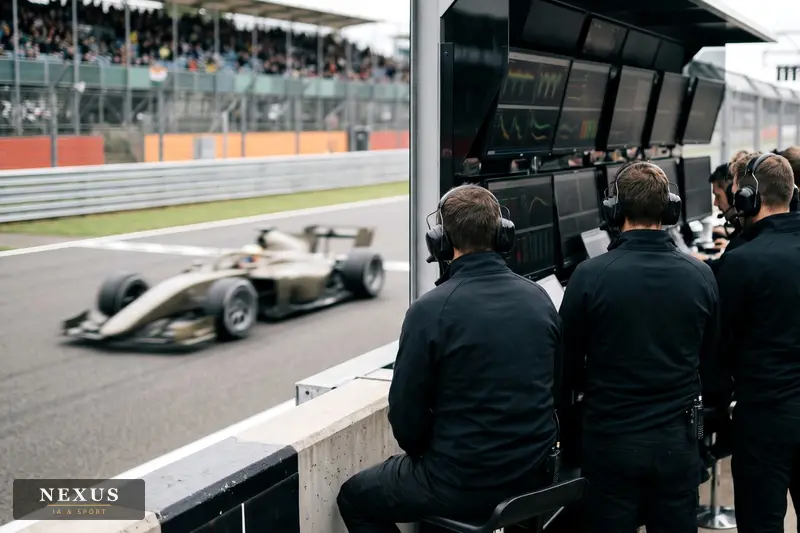
The most interesting work may happen after each stage. Teams collect data on speed, temperature and suspension, and analysing it can genuinely help them prepare the vehicle. That is less exciting than a robot co-driver, but it is where computing earns its place. We see the same pattern in Formula 1 and ocean racing: the machine measures, and a person decides.
What to watch in January
Three things will show whether this Moroccan Dakar works. The first is safety, since a route designed in two months leaves less time for reconnaissance. The second is navigation, because new terrain may shake up the order between Saudi regulars and specialists on African tracks. The third is what it does to the event itself. If this return is a hit, the Saudi agreement and African nostalgia will make for a fascinating debate.
One last caveat: the dates still need approval, and details may change before 9 January. We will update this article if the route moves.
Key takeaway
The 2027 Dakar leaves Saudi Arabia for Portugal and Morocco, bringing Africa back onto the map for the first time since 2007. In the desert, the technology that counts is still a digital roadbook and a good navigator.
Frequently asked questions
Where is the 2027 Dakar Rally?
In Portugal and Morocco, from 9 to 23 January 2027, subject to calendar approval. It starts in Loulé and finishes in Marrakech.
Why did the Dakar leave Saudi Arabia for 2027?
Organisers cited recent events in the Middle East, and the press links the move to the regional conflict. A return to Saudi Arabia is planned for 2028.
Does the 2027 Dakar go to Dakar?
No. The name comes from the old Paris-Dakar. The finish is planned for Marrakech.
How long is the 2027 Dakar?
The announced total is 7,824 km, including 4,341 km of timed specials.
Does AI guide Dakar drivers?
I found no evidence of that. Crews use a digital roadbook received shortly before the start, and the rules limit outside help.
Sources and method
This article draws on 8 sources, listed below. References checked in November 2026. Artificial intelligence tools help with research and writing: our method explains how. Found a mistake? Let us know and we will correct it and say so on the page. This article is for information and does not replace the advice of a doctor or sports professional who knows your situation.
- Crash.net (30 October 2026), Dakar announces new route after Saudi cancellation
- Jalopnik (2026), the 2027 Dakar route and the context of the war
- Yabiladi (2026), the Moroccan route and distances
- Racer (30 October 2026), Dakar set for a Portugal-to-Morocco route
- France Racing (2026), the Dakar returns to Africa and reveals its 2027 route
- DirtFish, how navigation is evolving on the Dakar
- Enduro21, the debate over digital roadbooks
- BRM, digital roadbooks and waypoints for riders