The headline number is irresistible: more than a million data points a second, streaming off every car. The figure is impressive, and it is not where races are won. The real action comes earlier, in simulations that run the Grand Prix thousands of times, and under rules that deliberately limit how much data the best teams may generate.
Telemetry, without the hype
Formula One and Amazon Web Services quote about 300 sensors per car and more than 1.1 million data points a second, covering speed, tyre pressures and temperatures, engine condition and fuel use. Those are marketing figures and hard to verify from outside, though the scale fits what engineers describe.
Most of it is there to keep the car alive. Engineers in the garage and at the factory spot a rising temperature or a falling pressure before the driver does. Afterwards it explains why one lap was slower than another.
Running the race before the race
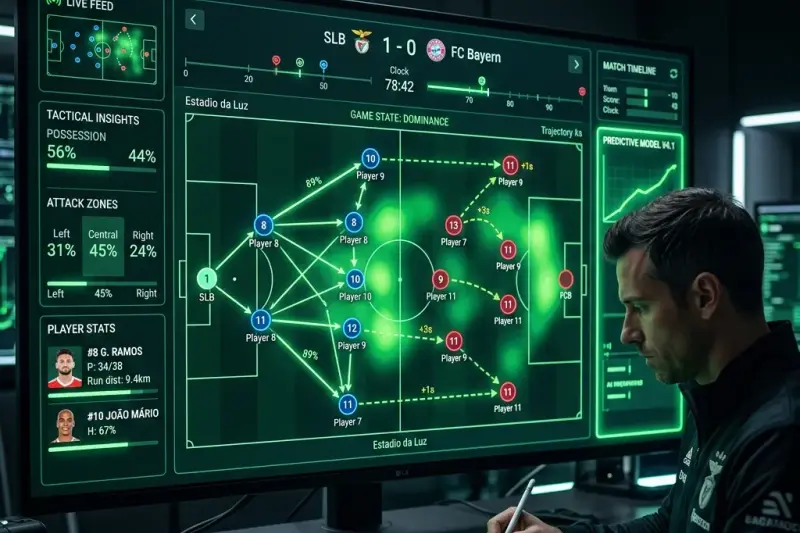
Teams use simulators that play a Grand Prix thousands of times with random events thrown in: a safety car, a botched stop, tyres going off faster than expected.
In 2020, a Technical University of Munich team published a Monte Carlo model of this kind. The goal is to find the strategy that survives the most surprises, which may not be the one that looks quickest. A stop that gains two seconds on average can be a bad idea if it leaves you exposed to a badly timed safety car.
The more you win, the less you can test
Since 2021, permitted wind tunnel and aero computing time has depended on last year’s standings. From 2022, the champions get 70% of the reference allocation and the last-placed team 115%, in steps of 5 points. The order is recalculated during the season, and tunnel models are limited to 60% of full size.
A spending cap arrived in 2021 too, at 145 million dollars in its first year, excluding items such as driver salaries. Teams can no longer test everything, so simulation is used to pick which ideas deserve scarce tunnel hours. Getting the most from each run is now an advantage in itself, and that is where machine learning comes in.
What changed in 2026
The new engines dropped the MGU-H, which recovered energy from the exhaust. The electric MGU-K jumped from 120 to 350 kilowatts, close to half of total power, and the cars run on fully sustainable fuel.
Aerodynamics went active as well, with wings switching between a high-downforce corner mode and a low-drag straight-line mode. DRS, used since 2011 to help overtaking, is gone.
Why software may now decide races
With so much electric power, energy management is decisive. Where do you recharge the battery? Where do you empty it? How do you keep enough to attack or defend at the end of a straight? Algorithms prepare those choices and the driver adjusts them during the race.
Two cars with identical engines can now perform differently because of their energy strategy. That is a place where clever calculation shows up directly on the stopwatch.
When the model meets reality
Every simulation rests on assumptions. Misjudge tyre wear or get caught by a change in the weather, and the best calculated plan turns into the wrong one. Strategists have seconds to decide whether to stick or twist.
And there is still the driver. Telemetry shows where they brake and how they accelerate, but engineers keep listening on the radio for what the car feels like. The data do a lot of deciding in Formula 1. A person still has the last word.
Key takeaway
In Formula 1, the most valuable data are the data you are not allowed to produce in unlimited amounts. The 2026 rules have made energy management as important as the wind tunnel.
Frequently asked questions
How many sensors does a Formula 1 car have?
About 300 according to Formula One and AWS, for more than a million data points a second. These figures come from their publicity.
Why does the champion get less wind tunnel time?
To close up the field. Since 2022, the champion team has been entitled to 70% of the reference allocation and the last-placed team to 115%.
What changes in 2026?
The MGU-H goes, electric power rises to 350 kilowatts, the fuel is fully sustainable and active aerodynamics replace DRS.
Can a simulation predict the winner?
It helps choose the strategy that best withstands the unexpected. It cannot predict a safety car or a downpour.
Does AI drive the car?
No. Algorithms prepare strategies and settings, the driver drives and engineers decide during the race.
Sources and method
This article draws on 4 sources, listed below. References checked in October 2026. Artificial intelligence tools help with research and writing: our method explains how. Found a mistake? Let us know and we will correct it and say so on the page. This article is for information and does not replace the advice of a doctor or sports professional who knows your situation.