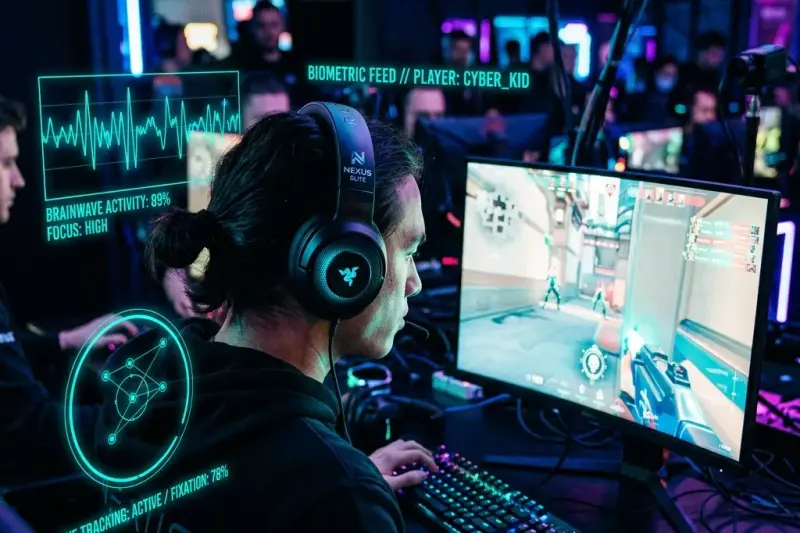
Watch a top shooter player from behind and the crosshair seems to know where the enemy will be. Put an eye tracker on them and you can see why: their gaze does less and gets there sooner. The results are fascinating and they all point the same way. Before you buy anything, look at how many players were in the studies.
How gaze gets measured
An eye tracker is a small infrared camera under the screen that films your eyes and works out several times a second where you are looking. It gives two main measures: fixations, when the eye stops on a point, and saccades, the quick jumps between them.
Researchers have long used it in traditional sport, for example on goalkeepers facing penalties. Esports is a natural fit, since all the action sits on a screen right in front of the camera.
In shooters: one jump to the target
A 2025 study in Computers in Human Behavior compared 28 experienced first-person shooter players with 35 people who did not play them. The experienced group used fewer fixations and fewer saccades to aim at a target.
Their most common pattern was a single saccade straight to the target. The authors read that as more efficient searching: the expert knows where to look and goes there.
In World of Warcraft: looking past the flashy stuff
In 2017, Yousri Marzouki and colleagues showed four experts and four beginners 24 video clips of the game. Experts looked more at the useful areas of the screen, even when these were hard to see, rather than at whatever grabbed the eye.
The authors call that better gaze control, learned through experience. They also call their eight-person study exploratory, and they are right to.
Counter-Strike, and the four-player warning
In 2019, a team led by Boris Velichkovsky proposed fixation length as a marker of skill in Counter-Strike. The best players had more variable durations, with some very short fixations and some very long.
The professional group had four people in it. That is an interesting lead and no basis for talent spotting. If a training centre ever claims it can find a champion by their gaze, ask how many players its method is built on.
FIFA did not fit the pattern
A 2020 study of 21 FIFA 19 players found almost no difference between professionals and non-professionals in the number and length of fixations. Professionals did look at the radar more, and they glanced more briefly at teammates away from the ball.
Expertise does not look the same in every game. What matters in a shooter is not what matters in a strategy or sports title.
Can you train your eyes?
Probably, but we do not know how yet. Gaze training has worked to a degree in traditional sport, for penalty takers among others, with limits under pressure. In esports, training studies are rare. We are better at describing how experts look than at teaching it.
An eye tracker is best used to review a game and find out why you missed a threat. Consumer models exist, with variable accuracy.
The free version
The good news from all this is that gaze improves with practice, and that experts look less and better. You do not need any hardware to work on it.
Replay your games and at every mistake ask one question: where was I looking?
Key takeaway
Esports experts look less and look better. But many of the studies rest on a handful of players, and nobody can yet detect talent from gaze.
Frequently asked questions
What is eye tracking?
A technique that films the eyes with an infrared camera to find out where a person is looking at each moment.
Do expert players look differently?
In shooters, they make fewer fixations and go more directly to the target, according to a 2025 study.
Can talent be spotted through gaze?
Not today. The studies that suggest it involve only a few players.
Are the results the same in all games?
No. In FIFA 19, the differences between professionals and amateurs were small, apart from use of the radar.
How can I work on my gaze?
Reviewing your games and asking where you were looking at each mistake is a good start.
Sources and method
This article draws on 4 sources, listed below. References checked in October 2026. Artificial intelligence tools help with research and writing: our method explains how. Found a mistake? Let us know and we will correct it and say so on the page. This article is for information and does not replace the advice of a doctor or sports professional who knows your situation.
- Yang et al. (2025), eye movements of experienced first-person shooter players (Computers in Human Behavior)
- Marzouki et al. (2017), the gaze of World of Warcraft experts (PeerJ)
- Velichkovsky et al. (2019), fixation duration as an indicator of esports level (INTERACT 2019)
- Bickmann et al. (2020), the gaze of professional and non-professional FIFA 19 players (International Journal of Gaming and Computer-Mediated Simulations)