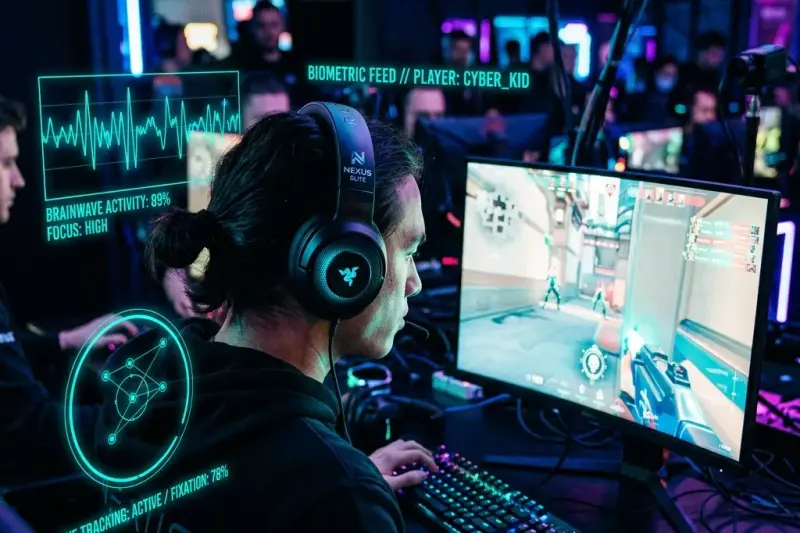
It is late, you have lost three in a row, and you are sure the next one will be different. It rarely is. A tired player usually feels they are playing normally while the statistics say otherwise, and that gap between feeling and reality is what makes mental fatigue so expensive.
Decisions go before reflexes matter
A 2026 meta-analysis in BMC Psychology pulled together lab studies that induce mental fatigue and then test sports tasks. Its authors carefully separated reaction speed, technique and decision quality, which earlier work often lumped together. The effect has been studied for years. In 2009 Samuele Marcora showed that 90 minutes of a demanding mental task cut the endurance of 16 volunteers on a bike: they stopped sooner because the effort felt harder. In 2016 a study of twelve footballers found less accurate and slower decisions after 30 minutes of an attention test.
For esports players, decisions are the part to watch. You can recover from a slightly late reaction. A bad call on when to fight is much harder to undo.
How it feels from the inside
Mental fatigue does not announce itself like tired legs. You feel weary, you decide more slowly, you get irritable and you make errors you would not normally make. Add frustration and you have what players call tilt, which is not a scientific term but describes the slide well.
That is why it helps to check how you feel against a few hard numbers from your games.
The case for leaving your desk
A 2026 review in Sports Medicine Open gathered twelve studies on exercise and esports performance, mostly high-intensity intervals on a bike, walking or on a treadmill.
The results lean towards better attention and some gains in game performance. The studies are small, but they support a simple idea: moving your body is part of a player’s training. Even a short break can help. In a trial with 21 players, a six-minute walk in the middle of two hours of play improved scores on a planning test, compared with a seated break or playing straight through. Game performance itself did not change.
Sleep comes first
Too little sleep slows reactions and damages decisions. We know this from pilots, on-call doctors and drivers, and gamers have no special immunity.
Late matches and night practice make it harder. Even a late bedtime helps if it is the same every night.
Caffeine: it works, until it doesn’t
Caffeine is one of the few substances with a solid effect on alertness. The trouble is dose and timing. Several cans a day, one of them in the evening, end up wrecking sleep.
The European Food Safety Authority puts the safe limit for a healthy adult at 400 milligrams a day, about four cups of coffee. Many players go past that without noticing.
How good teams plan the day
They work in blocks. An hour or two of intense practice matches, then a real break away from the screen, then calmer video review. A workout or a walk fits easily in the gaps, and recent studies suggest it may sharpen attention in the next session.
The goal is to make each block count rather than to pile up hours. If accuracy drops, check the connection, the equipment and the opponent’s strategy too, before you blame fatigue.
Coaches sometimes have to protect players from themselves, setting limits on solo grinding late at night. Before a tournament they can taper as in any other sport, with less volume, short sharp sessions and more rest. That often beats ten-hour days right up to the eve of the event.
Rules for the rest of us
Decide your session length before you start. Take a proper break every hour. After two or three straight losses, stop rather than queue again in a bad mood.
Get some regular exercise, even if it is modest. A walk, a jog or a light strength session counts as training.
Key takeaway
Fatigue loses games in esports too. Regular breaks and a bit of exercise belong in your training plan.
Frequently asked questions
Does a slower reaction prove fatigue?
No, it is a signal to put in context: sleep, session length, connection and how the player feels.
Which sport would you suggest for an esports player?
Studies mainly test short interval sessions. Any regular activity the player enjoys is a good start.
How long should you play in one go?
There is no fixed rule, but regular breaks, at least every one to two hours, limit the drop in performance.
Is “tilt” a real phenomenon?
It is a gamers’ term, not a scientific concept, but it describes well the mix of frustration and fatigue that multiplies mistakes.
Should you stop playing after several defeats?
It is often a good idea. Frustration and fatigue increase mistakes, and a break lets you restart with a clearer head.
How many hours of sleep for an esports player?
The same as any adult, about seven to nine hours. Regular hours also matter a lot, even when matches finish late.
Do energy drinks improve performance?
The caffeine they contain improves alertness. But sugar, high doses and late consumption damage sleep, which ends up costing more than they give.
Sources and method
This article draws on 5 sources, listed below. References checked in November 2026. Artificial intelligence tools help with research and writing: our method explains how. Found a mistake? Let us know and we will correct it and say so on the page. This article is for information and does not replace the advice of a doctor or sports professional who knows your situation.
- Lu et al. (2026), mental fatigue, reaction, technique and sports decisions, meta-analysis (BMC Psychology)
- Wachholz et al. (2026), physical exercise and esports performance, systematic review (Sports Medicine Open)
- Marcora, Staiano and Manning (2009), mental fatigue impairs physical performance (Journal of Applied Physiology)
- Smith et al. (2016), mental fatigue and decision-making in football (Journal of Sports Sciences)
- DiFrancisco-Donoghue et al. (2021), a six-minute walk during a long gaming session, randomised trial (BMJ Open Sport & Exercise Medicine)