Not long ago, measuring how someone moved meant a lab, reflective markers stuck to the skin and a technician. Now ordinary cameras and deep learning get surprisingly close. Combined with a virtual coach at home, this could change rehabilitation, and one large trial already suggests how. The key detail in that trial is easy to miss: a physiotherapist never left the room, so to speak.
Teaching software to find a knee
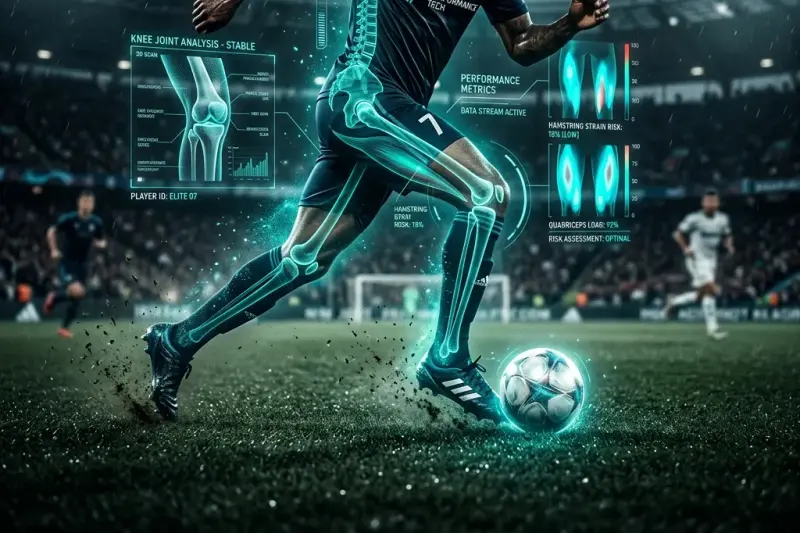
A neural network trained on thousands of hand-labelled photos learns to find shoulders, elbows, hips, knees and ankles in an image. With several cameras at different angles, software can rebuild the body in three dimensions.
OpenPose, a founding tool from Carnegie Mellon University described in detail in 2021, tracks several people on video in real time. Commercial products have since been built on approaches like it.
How close is it to the gold standard?
In 2021, Robert Kanko and colleagues at Queen’s University in Canada filmed 30 healthy adults walking on a treadmill with eight video cameras and seven infrared marker cameras at once.
Joint centres differed by less than 2.5 centimetres on average, apart from the hip at 3.6. Leg segment angles were within 5.5 degrees, except rotations around the limb’s own axis, which are harder to see in an image.
What that means in the clinic
For following knee bend after surgery or tracking a limp, that accuracy is often enough. The patient needs no equipment, sessions are shorter and you can measure more often.
For rotations, or differences of a few degrees, be careful. That study used healthy people on a treadmill in a well-lit lab, and your physio’s room or your lounge will not look like that.
The trial that tested rehab at home
The VERITAS trial, published in 2020, tried something bolder after total knee replacement: patients worked at home in front of a camera with an avatar guiding them, while a physiotherapist followed their results remotely.
Of 306 patients randomised across four US centres, 287 finished. Outcomes for knee function, mobility and walking speed were comparable to conventional rehab, at home or in a clinic.
Much cheaper, and not without a physio
Cost was the main question. Over the twelve weeks after discharge, median care cost 1,050 dollars in the virtual group and 2,805 in the conventional group. Falls and readmissions were no more common.
What made that work is the detail worth remembering. A physiotherapist stayed in the loop, watching the data and stepping in remotely. VERITAS did not test an app on its own. It tested human care made more efficient by technology.
What this does not tell you
Knee replacement is a very standardised operation. These results say nothing about a footballer’s cruciate rupture, an ankle sprain or back pain, and each of those needs its own trials.
A camera in your home also sees more than your knees. Ask where the images are stored, who has access and how long they are kept.
For athletes coming back
Clubs already use video to compare an injured player with how they moved before, or the operated leg with the other one. Markerless capture makes that easier and more frequent, on the pitch rather than in a lab.
It will not tell you when someone can return. That decision rests on strength, jumping and running tests along with the doctor’s view, and the camera is only one part of the file.
A recent meta-analysis of OpenCap
OpenCap is a free tool developed at Stanford University: two smartphones film the patient and software calculates the joint angles. A review with meta-analysis, published in late 2025 in Biology of Sport, pooled 12 studies and 184 participants. The average gap with reference systems is about 5 to 6 degrees, and repeatability ranges from moderate to very good depending on the joint and the movement.
The authors note an important limit: accuracy drops for fast movements. For a squat or walking, the tool is often enough to follow rehabilitation. To judge a return to sport after an injury, such as Romain Ntamack’s shoulder dislocation (in French), it remains a complement to the physiotherapist’s examination, not a replacement.
Key takeaway
Markerless cameras measure walking well enough to follow rehabilitation. They make a physiotherapist more efficient. They do not replace one.
Frequently asked questions
Can an ordinary camera measure movement?
With several cameras and suitable software, joint position is measured to within about 2.5 centimetres in a validation study on walking.
What does markerless capture measure poorly?
Rotations around the limb’s axis, and small differences of a few degrees.
Does remote rehabilitation work?
After knee replacement, the VERITAS trial found results comparable to conventional rehabilitation, at lower cost.
Can you do without a physiotherapist?
No. In the trial, a physiotherapist followed the data remotely and stepped in when needed.
Are these tools useful for injured athletes?
They help compare movements before and after injury. The decision to return combines other tests and medical advice.
Sources and method
This article draws on 4 sources, listed below. References checked in November 2026. Artificial intelligence tools help with research and writing: our method explains how. Found a mistake? Let us know and we will correct it and say so on the page. This article is for information and does not replace the advice of a doctor or sports professional who knows your situation.
- Kanko et al. (2021), markerless motion capture compared with the reference (Journal of Biomechanics)
- Prvu Bettger et al. (2020), VERITAS trial of virtual rehabilitation after knee replacement (Journal of Bone and Joint Surgery)
- Cao et al. (2021), OpenPose, real-time multi-person pose estimation (IEEE TPAMI)
- Çabuk et al. (2025), can OpenCap deliver valid and reliable kinematic data? Systematic review and meta-analysis (Biology of Sport)